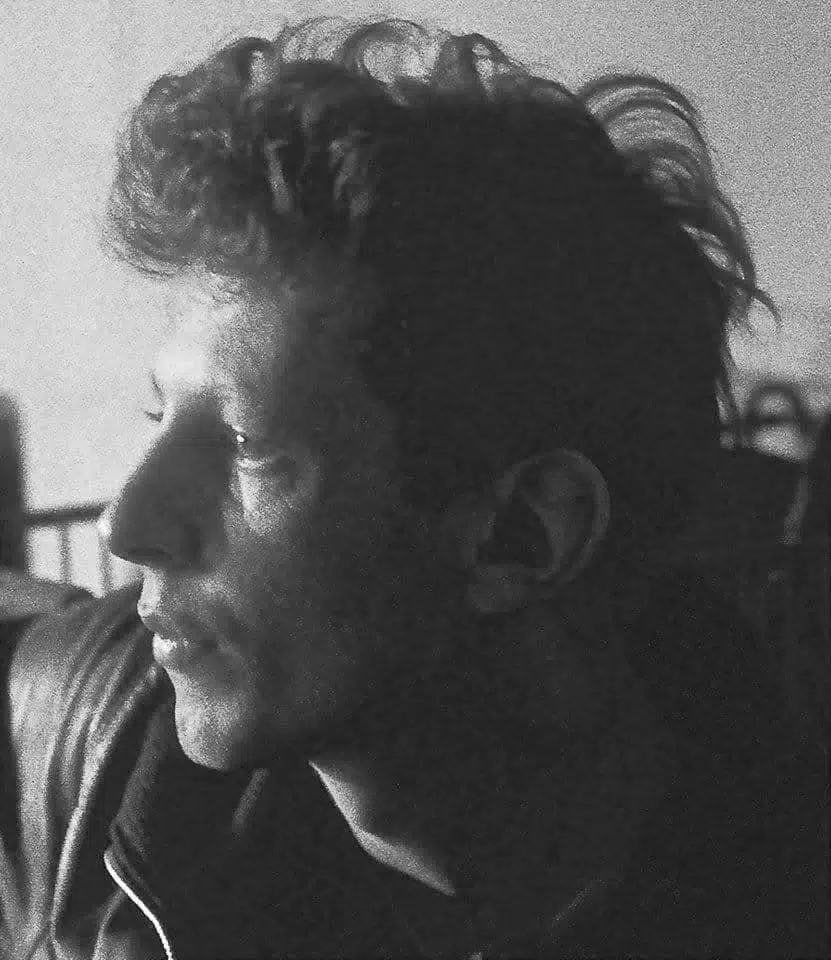
Chrislo Haas left too soon; but, in his time on the planet, he filled in the spaces left by disco and punk with electronic textures that shaped both EBM and techno.
Haas surfaced as a founder of the Zürich performance group, Minus Delta t. His path then took him down the autobahn to Düsseldorf’s Ratinger Hof. The connections he made there led him to take Kurt “Pyrolator” Dahlke’s place in Deutsch Amerikanische Freundschaft. During the band’s London stay, DAF slept on the floor at Daniel Miller’s mother’s house, and Haas made key contributions to Die Kleinen und die Bösen. He left once he had tired of playing live, and Gabi Delgado and Robert Görl distilled the group down to a duo. Along the way, he and Görl helped record Der Plan’s debut EP – a jam captured on a cassette dictation machine in a Düsseldorf cellar.
In 1981, Haas teamed up with Beate Bartel of Mania D. as CHBB, releasing four cassettes in editions of fifty copies. With the addition of vocalist Krishna Goineau, the project became Liaisons Dangereuses, whose sole album, mixed at Conny Plank‘s studio, became an underground monument. The group dissolved in 1982, having helped to define the template for EBM.
Haas later joined the Berlin wing of Crime & the City Solution and produced Paradise Discotheque, the last album of their Berlin years. In 1998, he released a twelve-inch and an album on Tresor. He died in Berlin on 23 October 2004, aged only 47. “Chrislo was a natural-born provocateur,” Delgado recalled in 2015, adding that Haas had influenced him more than Görl had. Haas shook up scenes and changed the way we danced like few others.
10. Minus Delta t – 19 (’80)
Minus Delta t was founded in Zürich in 1978 by Mike Hentz, Karel Dudesek and Chrislo Haas as a performance and media group. In 1980, the year Haas left, the collective contributed an untitled, single-sided flexidisc to ZickZack, given away with the first 3,000 copies of the compilation Geräusche für die 80er. The label would carry Die Krupps’ steel into the shops the following year.
Haas was an actionist – part of an art collective who positioned Robert Görl on the bar of the Ratinger Hof with his drums to prevent drinking at their shows. That sensibility – the subversive gesture as the artwork – never left his music. It simply found a more consistent instrument.
9. DAF – Osten währt am längsten
Haas’s sole DAF album was the first long-player on Mute: Die Kleinen und die Bösen, cut by Delgado, Görl, Haas and Wolfgang Spelmans. Conny Plank produced the studio tracks at his own studio, and they fill the first side and open the second. The rest was captured live at London’s Electric Ballroom. Haas is credited with synthesiser, tape and saxophone.
The title of this track translates as, “The East lasts longest” – a subversive punk uttering from the front lines of the Cold War, kept current by the trend for Ostalgia.
8. CHBB – Mau-Mau
CHBB’s name combines the initials of its members: Chrislo Haas and Beate Bartel. In 1981, the pair released a series of cassettes on the Düsseldorf tape label, Klar! 80. The tie-up came after Bartel had left Mania D. and Haas had wrapped with DAF.
The 2024 reissue – featuring nine known tracks plus eleven unreleased jams – did nothing to soften the claim that this is EBM’s Ground Zero.
7. Crime & the City Solution – The Bride Ship
In 1987, Simon Bonney and Bronwyn Adams, with Mick Harvey, recruited Haas on synthesiser for Crime & the City Solution, alongside Alexander Hacke of Einstürzende Neubauten and Thomas Stern. The Bride Ship was recorded in Berlin during 1988, partly at the Hansa Tonstudio, with Gareth Jones producing the vocals and mixing much of the record.
The title track runs for six minutes, built on Bonney’s ballad voice and the band’s slow accumulation. Haas supplies colour and undertow.
6. Chrislo – Hangars D’Orion
The Tresor label issued “Hangars D’Orion” as a twelve-inch in 1998. The flip carried Surgeon’s remix of “La Chouette” and a “Berlin Mix” of “2 CV D’Orion” from Regis.
Surgeon and Regis were then among the leading lights of British industrial techno, and this found them remixing the synthesist whose early-80s recordings had helped define their musical lineage.
5. Crime & the City Solution – I Have the Gun
Paradise Discotheque was recorded in November 1989 at Conny’s Studio in Wolperath, with Chrislo Haas producing. “I Have the Gun” opens proceedings.
Haas had first worked in Conny Plank’s room on Die Kleinen und die Bösen in 1980, and Liaisons Dangereuses mixed their album there a year later. He returned as a producer at the end of the decade.
The album stands as his most prominent production for another band: a taut, theatrical record made two years before the group split in late 1991.
4. Liaisons Dangereuses – Peut Être…Pas
The longest track on the Liaisons Dangereuses album runs to the length of a 12″ single. The notes on the reissue fairly name it, alongside “Los Niños del Parque,” as having played a decisive role in the development of the Detroit and Chicago house sounds, as well as European techno.
3. Phew – Like Water and Water
On Phew’s 1992 album, Our Likeness, Haas joined the Japanese vocalist alongside Can drummer Jaki Liebezeit, Einstürzende Neubauten guitarist Alexander Hacke, and Crime & the City Solution bassist Thomas Stern. Having first encountered Phew at Conny Plank’s studio in 1981, Haas later reconnected with her in Tokyo, assembled the musicians and introduced the project to Mute’s Daniel Miller.
“Like Water and Water” offers a particularly apt selection here: alongside his keyboards, Haas is credited with saxophone on the track; reminding us of the breadth of a musician too often remembered solely for his pioneering synthesizer work.
2. Chrislo – L’Eau
After Crime & the City Solution wound down, and a 1995 detour as Armed Response with Non-Eric, Haas reappeared as a solo act on Tresor, the Berlin techno label. Low, a double album released in 1998 under the name Chrislo, carries mostly French titles.
1. Liaisons Dangereuses – Los Niños del Parque
The second track on the group’s only album, produced by Haas and Bartel, with Goineau delivering what the reissue notes call “speech-attack lyrics” in French and Spanish – this is Europe’s answer to the death of disco. Mixed at Conny Plank‘s studio, and still cited by legendary Chicago house and Detroit techno DJs as a crucial influence, it tells the story of the kids in the park.
The combination of a step-sequenced bassline leading the song with spoken lyrics became a model for EBM. Haas built the sound with Bartel. Two decades after his death, every minimal club still pays its rent with this track in the mix.