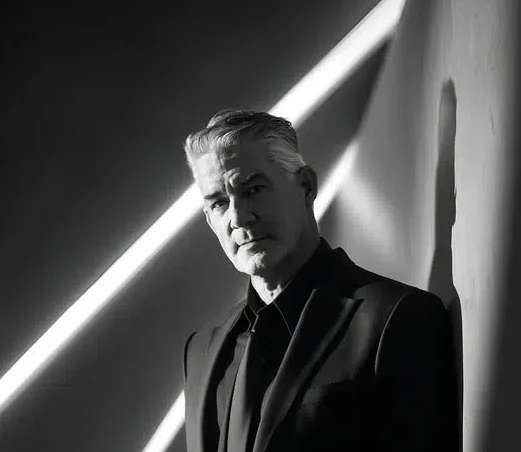
Graeme Revell was working as a psychiatric nurse in Sydney in the late 1970s when he and a fellow orderly started making the most unpleasant noise they could think of. SPK, the band that came out of that ward, cycled through names as brutal as its early records, including Sozialistisches Patientenkollektiv and Surgical Penis Klinik – whichever version best suited the moment. Revell fed the group’s sleeves and manifestos with autopsy footage, military recordings, and the clinical language of the institution he worked in – and lied to the press about all of it on principle.
By the mid-1980s, the noise had softened into something closer to dance music; and, by 1986’s Zamia Lehmanni (Songs of Byzantine Flowers) it had turned into something closer to a score. A track from that album, “In Flagrante Delicto,” found its way to the production team behind the Australian thriller, Dead Calm, and Revell wrote his first film music around it. He has built a huge profile in films since; moving effortlessly between arthouse commissions for Wim Wenders and studio work for Robert Rodriguez.
Revell’s two careers rarely acknowledged each other in public – at least, that is, until 2025, when he reactivated SPK for its first live shows in almost four decades with his son, Robert J. Revell. Few of the film executives who hired him for Mighty Morphin Power Rangers: The Movie would have known about his London squat years, and few of SPK’s old audience expected the man with the flamethrower to end up with eight BMI Film Music Awards and a David Twohy movie franchise.
10. SPK – Slogun
“Slogun” appeared in 1979 as the B-side to SPK’s “Factory” single. Its lyrics were inspired by the slogans of a West German political group, Sozialistisches Patientenkollektiv, that blamed capitalism for mental health disorders and preached revolt as a cure: “Kill, kill, kill for inner peace / Bomb, bomb, bomb for mental health / Therapy through violence.”
Revell and Neil Hill (Ne/H/il), the two psychiatric workers behind the band’s earliest incarnation, recorded it as a blunt piece of agit-noise rather than a song: distortion swallowing the vocal until the slogan itself becomes the only clear signal.
9. SPK – Napalm (Terminal Patient)
Leichenschrei, SPK’s second album, arrived in 1982 with no printed track titles on its first pressing. Built from a gravelly, looped track and insistent metal, “Napalm (Terminal Patient)” is one of its most concentrated moments.
8. SPK – Metal Dance
Written with Sinan Leong Revell and Derek Thompson, “Metal Dance” was SPK’s move toward something playable in a club rather than only unbearable on headphones. It reached the UK Indie top five in October 1983 before a re-recorded version appeared on 1984’s Machine Age Voodoo. The drum machine still hits like tooling in a factory, but Sinan’s vocal gives the track a melodic hook where the earlier records offered only pressure.
Longtime listeners took it as a surrender to commercial forces, and Revell has never fully disagreed. He needed money for a young family, and the Fairlight sampler the record’s advance eventually paid for changed what he could do next.
7. SPK – In Flagrante Delicto
A track from 1986’s Zamia Lehmanni (Songs of Byzantine Flowers), “In Flagrante Delicto” traded SPK’s earlier abrasion for something closer to processional music, with strings and voice moving at the pace of a ritual rather than a dancefloor. It led to Revell’s first work in film.
6. Graeme Revell – Storm Is Coming
Revell’s score for Dead Calm – his first – won the AFI Award for Best Original Music Score in 1989. It marked the point at which the industrial musician pivoted to Hollywood.
5. Graeme Revell – Until the End of the World
Wim Wenders hired Revell to score the framing passages of his 1991 road movie Until the End of the World, bookending an alternative-rock soundtrack with material of his own. His contribution blends string writing with Aka pygmy vocal recordings – the same instinct for pairing orchestral frameworks with ethnographic source material that would define his biggest studio scores.
4. Lori Carson & Graeme Revell – Fall in the Light
Kathryn Bigelow hired Revell for Strange Days fresh from his assignment on The Crow, largely to replace a temporary score derived from the music of Deep Forest. “Fall in the Light,” written and performed with singer-songwriter Lori Carson, closes the film over its turn-of-the-century climax; Carson’s voice sitting dry against a bed of programmed percussion and synthesiser wash.
3. Graeme Revell – Sex Machine Attacks
Robert Rodriguez and Quentin Tarantino’s vampire film, From Dusk to Dawn, gave Revell almost no room on its own soundtrack album – just two brief cues squeezed between Texas blues and Tito & Tarantula tracks. “Sex Machine Attacks” runs under ninety seconds.
Revell has described his pitch for the score as a mariachi surf opera, and the surviving fragments back that up.
2. The SPKtR – The Last of Men
Revell reactivated SPK in the summer of 2025 with his son, Robert J. Revell. The new project, billed as The SPKtR, released its debut single, “The Last of Men,” in March 2026. The division of labour is plain from how Revell describes it: Robert supplies the instrumental attack, built on years of metal and deathcore listening, while Revell composes and arranges around him – much as he once arranged Fairlight parts around a singer.
The lyric is aimed at what Revell calls “the end of human centrality” rather than any literal apocalypse. “AI is simply the contemporary coal face,” he has said of the technology bound up in the song’s writing. “It isn’t a shortcut or a replacement for artists. It’s an instrument.” Four decades after “Slogun,” the target has moved from the psychiatric ward to the server farm, but the method – turning found language into something closer to a threat – has not changed.
1. Jane Sibbery – It Can’t Rain All the Time
Co-written with the Canadian alt-folk singer, Jane Siberry, for Alex Proyas’s 1994 film, The Crow, “It Can’t Rain All the Time” plays over its closing scenes. The lead actor, Brandon Lee, died during production, and the song carries that weight – whether or not it was written with it in mind.
The track is the clearest point in Revell’s catalogue where the SPK-era appetite for unfamiliar sound sources and the Hollywood-era need for a tune coincide.