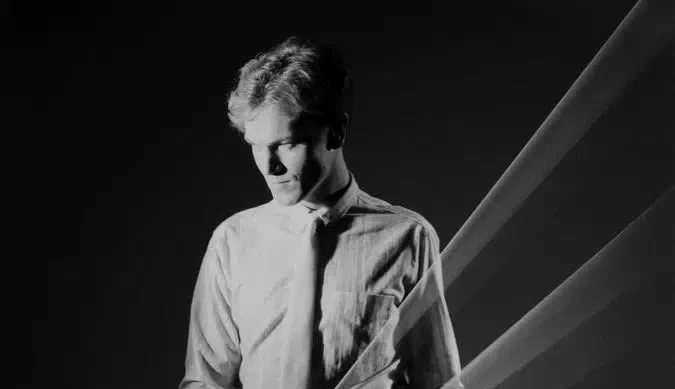
John Foxx dreams of moving alone through lost cities, forgotten towns, grown-over pavements, and abandoned streets. It is fitting, therefore, that he built his studio, The Garden, in the warehouse zone of Shoreditch and left before the hipsters and craft beer tasting flights moved in.
Depeche Mode recorded Construction Time Again there, but Foxx demurred, when asked by Daniel Miller to help make the album; pointing, instead, to house engineer Gareth Jones. Jones had worked on Foxx’s innovative and monumental record, Metamatic, and shared its DNA.
Foxx had his own projects to complete in 1983; principally, The Golden Section album, for which he and Depeche Mode shared a cover photographer in Brian Griffin. Although consciously electronic, it showcased Foxx’s psychedelic tastes and a warmth excluded from the austere, hand-played sequences of his early solo material.
The shedding of skins has been part of Foxx’s pattern from the beginning. Raised in Chorley, in Manchester’s shadow, and educated at art college, the man known to the government as Dennis Leigh refused a punk label, ditched Ultravox!, and turned his back on robotica when Gary Numan started to copy him to the point of parody. The success of tracks like “Underpass” led him to seek more organic sounds and ways of working. Ambient collaborations with Harold Budd gave way to dance music with Nation 12, which opened the door to an analogue synth revival with Louis Gordon, and then solo piano work.
Along the way, he has written a book named for his alter ego, The Quiet Man, and been awarded an honourary Ph.D. Dr Foxx continues his journey between pastoral streets and urbanised gardens with the calm of someone who has already accepted that the future will be lonely and individuals will be invisible, no matter how many cameras point at us.
10. Ultravox!- Hiroshima Mon Amour
Ultravox! started in 1974 but took a couple of years – and name changes – to find its feet. In 1976, the band was signed to Island Records, including the exclamation point in a nod to the Krautrock legends, Neu! Steve Lillywhite and Brian Eno produced their eponymous debut, giving them a sound borrowed from Roxy Music, Kraftwerk, and the New York Dolls.
Foxx wrote “Hiroshima Mon Amour” with Billy Currie and the Canadian drummer, Warren Cann. The album version uses Cann’s rhythm machine and Currie’s keyboards, with Chris Cross on bass and C.C. of Gloria Mundi on saxophone. Foxx sings and plays guitar. The drum machine proceeds without emphasis. Saxophone warms the edges, while Foxx describes intimacy through distance and damaged history. He later identified the track as an early proof that one person, inexpensive electronics and an eight-track studio could open unexplored territory.
The band lasted for three albums before Foxx left to try out that approach, taking the punctuation mark with him. Like Genesis, fans divide the history of Ultravox!/Ultravox/U-Vox into stages. The one with Foxx at the front of the stage is distinctive for its influence.
9. John Foxx – This City
“This City” appeared on the second disc of the limited double 7-inch edition of “No-One Driving” in March 1980. Recorded at Pathway during the Metamatic sessions, it reflects Foxx’s interests in the urban environment, trans-Atlantic post, and the potential of drum machines.
A nervous mechanical rhythm pushes against broad synthesiser chords. Foxx delivers the words in clipped phrases, drained by the streets he describes. The city becomes a closed electrical circuit. Every route leads back into the enveloping crowds in which the individual disappears.
8. John Foxx – Endlessly
Foxx first released “Endlessly” in 1982, then re-recorded it with Zeus B. Held for The Golden Section and a new single in 1983. Brian Griffin photographed the album cover, using tungsten light to produce its golden colour, while Foxx made the collage graphics for the single sleeve.
The remake replaces the first version’s Linn drum pattern with Simmons drums and a firm sequencer. The rhythm carries Foxx’s voice into a brighter register, and the chorus seems to accelerate each time it returns. Romantic pop has entered the machinery and given it warmth.
7. Nation 12 – Remember
“Remember” returned Foxx to records in 1990 through a collaboration with Tim Simenon of Bomb the Bass. Kerry Hopwood programmed the track, while Foxx supplied vocals and vocoder; Foxx and Simenon share the writing credit.
The voice arrives in short phrases. Acid-house rhythm replaces the measured pulse of Metamatic, but the sense of an isolated figure inside a system remains. Foxx later joked that the project took him out of the freezer and put him into the microwave.
6. John Foxx – Avenham Collonade
Foxx began the Cathedral Oceans material during the 1980s and performed versions in churches and gardens before issuing the first album in 1997. The album credits him with vocals, guitar, production and engineering.
Voices return through long electronic delays and meet their own reflections. Chords change slowly, allowing overtones to gather around them. Foxx described the project as a technological continuation of ancient chant: singing into a large electronic space and harmonising with the sound that came back.
5. John Foxx and Louis Gordon – From Trash
From Trash was released by Metamatic Records in November 2006. Foxx and Gordon wrote, arranged and produced the album together. Foxx traced its ideas to their Northern working-class backgrounds and the routes opened by pulp culture.
The title track drives a hard sequencer into the blunt force of an EBM rhythm. Foxx delivers the refrain as a collective slogan, with Gordon’s electronics tightening around each repetition. Refuse becomes the source material, but also a self-deprecating description of the artists. A damaged culture can still build its own machines.
4. John Foxx and Harold Budd featuring Ruben Garcia – Down a Windy Street
Harold Budd was a key figure in the avant-garde, who sadly fell victim to Covid-19 in 2020. His treated piano parts were inspired by Brian Eno’s template for ambient music, and he worked with Eno, Cocteau Twins’ Robin Guthrie, and Foxx to make expansive, spacious sounds with infinite reverb. For Nighthawks, Budd and Ruben Garcia sent recordings to Foxx, who placed them inside an environment assembled from New York street and subway sounds before adding his own parts.
“Down A Windy Street” moves through low light and blurred traffic. Piano phrases appear briefly, then dissolve into the urban field. The production recreates a city as memory: lit windows seen through rain, then distance.
3. John Foxx and The Maths – Last Time I Saw You
Howl reunited Foxx with Robin Simon, the guitarist from Ultravox’s Systems of Romance. Benge and Hannah Peel completed the line-up, bringing analogue electronics and violin to a record made at Benge’s MemeTune studio.
Simon opens “Last Time I Saw You” with a distorted guitar figure that keeps scraping against the electronic frame. Foxx treats his voice until authority turns unstable. The song is controlled, but irritation leaks through every surface. Four decades have passed since the last Ultravox! album with Foxx. This track holds state as if it was born into it.
2. John Foxx – The Quiet Man
Foxx’s first book was published in 2020, but the preparatory work began in 1977. A collection of short stories, it borrowed the title and the core image from an old 1950s grey suit Foxx bought from a charity shop. Wearing it gave him a sense of anonymity after the exposure of touring with Ultravox! From that came the phrase, “the quiet men,” the 1978 Ultravox! song, “Systems of Romance,” and eventually the literary figure/world of The Quiet Man.
1. John Foxx – When She Walked In with the Dawn
The opening track on Wherever You Are established the sound for the rest of the 2025 album. Foxx handled the writing and recording, then produced every piece. The instrumentation is piano and reverb, with no synthesiser or string machine in sight.
Chords are allowed to fade until the piano strings produce a second, softer body of sound. Foxx plays sparingly and follows the harmonic movement rather than imposing a tune on it. The old preference for minimal equipment survives, but electricity has been replaced by sympathetic vibration. As with the Cathedral Oceans material and Harold Budd collaborations, Foxx has a talent for letting things take shape so that they can dissolve. The man who wanted to become a machine reflects the journey of life in a moment of hearing.