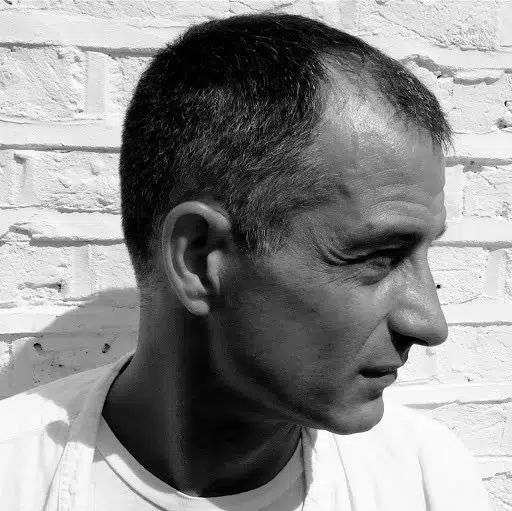
Mark Brydon was born in Sunderland in December 1960. He made his name a few hundred miles south, as the bass player in Chakk, a Sheffield industrial funk band whose 1986 album deal with MCA left them with no hit records; but, arguably, something better.
The advance from the label was supposed to be blown on clothes, cars, and cocaine, but it was invested, instead, in something more enduring. Chakk’s album sold poorly, and the band returned to their own Fon label (reputedly, named for the anti-fascist acronym, “F- Off, Nazis!”) before splitting in 1987. Brydon and co-founder Alan Cross, both former architecture students, weren’t out of a job, though: they had already used the MCA money to invest in FON Studios, located in a building over a metal treatment works that had been a karate club.
FON turned into a production and remix operation known as Fon Force. Through the late 1980s and early 1990s, Brydon worked the desk for other people’s records – from house and disco singles for Sheffield contemporaries, such as Krush and The Funky Worm, through to remix and production assignments for established names, including Cabaret Voltaire and Art of Noise. None of it made him a household name. It gave him a technical vocabulary in disco, house and electro that he would spend the next decade applying to songs rather than just sound systems.
That shift happened in 1994, when Róisín Murphy introduced herself to Brydon at a Sheffield party with a line memorable enough that it became an album title. Moloko turned a chat-up joke into four records between 1995 and 2003, moving from trip hop-flavoured electronica toward the string-and-acoustic-guitar pop of their later singles. Brydon and Murphy’s romantic relationship ended in 2002, shortly before they made their fourth album together. Murphy toured it without him. That was the end of an era but not the last we’d see of Brydon.
10. Chakk – Out of the Flesh
Chakk’s first single, released on Cabaret Voltaire’s Doublevision label in 1984, was produced by Richard H. Kirk and reached the upper reaches of the UK independent chart on the strength of a sound the band called industrial funk: metallic guitar scraped over a rhythm section built for movement rather than noise. Brydon played bass. He also paid close attention to the working model the Cabs had set up: using their Virgin Records advance to build up Western Works and finance their own label.
9. Chakk – Timebomb
After MCA dropped them, Chakk went back to their own Fon label for “Timebomb”, released as a single and 12-inch EP in 1986. It is one of the great “missing” artefacts of 1980s dance music, despite reaching number 20 on the UK independent chart.
The track itself is tighter than the band’s earlier singles, built on a mechanical chug rather than the elastic funk of “Out of the Flesh”. It anticipates the disciplined, rhythm-first work Brydon would move into as a producer. It was the sound of a bass player already thinking like an engineer.
8. Krush – House Arrest
“House Arrest” was Brydon’s first production credit away from his own band, made with fellow FON engineer Robert Gordon for a trio of Sheffield musicians – Cassius Campbell, Mark Gamble and Ruthjoy Built from a sample loop and a four-on-the-floor pulse, it reached number three on the UK singles chart in January 1988, arriving alongside Bomb the Bass and S’Express as one of the records that introduced British audiences to house music on daytime radio.
It is a strange record to hear now: a genuinely early house single made in a Yorkshire cutlery-factory conversion rather than Chicago; produced by two men who had spent the previous few years working on guitar-based industrial funk. Brydon’s engineering background shows in how the loop sits against the low end – tidier than most of the track’s dancefloor contemporaries.
7. The Funky Worm – Hustle! (To the Music…)
Brydon produced and co-wrote “Hustle! (To the Music…)” with Carl Munson, Julie Stewart and Richard “Parrot” Barratt; crossing disco revivalism with the house rhythms the Fon team had spent the previous year absorbing. Julie Stewart’s lead vocal sits over a horn-inflected groove built for peak-time play, and the single reached the UK top 40 in 1988.
Where Krush borrowed house’s mechanics, “Hustle!” is a pop song wearing them, built around a hook engineered for radio rather than only for a club floor. It is the clearest early evidence that Brydon could write a chorus, as well as programme a rhythm track – a skill Chakk rarely asked of him.
6. Cabaret Voltaire – Easy Life
By 1990, the band who had once produced Chakk’s debut single were bringing Brydon in as a co-producer on their own record. Groovy, Laidback and Nasty was recorded partly in Chicago with house pioneer Marshall Jefferson and credits backing vocals to Ten City, among its guest contributors. Brydon’s contributions were to “Easy Life,” which had more humble origins, back in Sheffield.
The track runs on a slow, rolling house groove that contracts sharply with Cabaret Voltaire’s earlier tape-collage abrasion. Brydon’s presence in the credits marks how far the working relationship between Fon and the band that inspired it had turned around: the students producing the teachers.
5. Jesus Loves You – Love’s Gonna Let You Down
Boy George’s post-Culture Club vehicle, Jesus Loves You, gave Brydon a rare full-service credit: producer, engineer, mixer and co-writer on “Love’s Gonna Let You Down.” Brydon’s mix favours space and a steady low pulse over the arrangements George’s voice could otherwise invite. It is evidence of a producer coming to terms with restraint – a preference that would define his work with Moloko a few years later.
4. Art of Noise – L.E.F.
The Fon Mixes, a 1991 remix album built around Fon Force’s Sheffield contacts, handed Brydon one of the collection’s named reworkings: “L.E.F. (The Mark Brydon Mix)”. Brydon’s mix strips the original’s orchestral sampling down toward rhythm and low frequency. It’s the same instinct that made his house and dance productions work: find the pulse first; then be selective in what surrounds it.
3. A Certain Ratio – Blown Away
Brydon’s “Puffin’ Stuff Mix” of A Certain Ratio’s “Blown Away” appeared on 1994’s Looking For A Certain Ratio, a remix compilation drawing on the Manchester band’s back catalogue. The commission arrived the same year Moloko formed, making it one of Brydon’s last outside production jobs before Murphy became his main collaborator.
It carries the loose, low-slung swing of his FON-era work rather than anything more song-oriented – a final demonstration of the specific dancefloor competence that other artists had been hiring him for since “House Arrest.”
2. Psychic TV – Love War Riot
Psychic TV joined up with Brydon to produce “Love War Riot” in 1987, but it only saw the light of day in 1989; bursting into the heady club days of alternative dance music. The Fon team went to town with vocodered remixes, helping Genesis P-Orridge with their campaign to become the leading light of the Acid House.
1. Moloko – Sing It Back
Murphy wrote the lyrics to “Sing It Back” while out clubbing in New York, and Moloko’s own version, from 1998’s I Am Not a Doctor, was dismissed by NME at the time as “some of the limpest, radio-friendly handbag tedium ever put on wax.” Brydon and Murphy disliked a commissioned Todd Terry remix and pushed their label toward Boris Dlugosch’s version, instead, which turned the song into a UK top five hit and a US number one dance single.
It is a string-laden pop song from a man who spent the 1980s wiring together a studio to make dance records in a former cutlery works. “Sing It Back” demonstrates exactly what fifteen years of production work had taught Brydon: how to build a track around a voice, rather than the other way round.
The episode says as much about Brydon’s judgement as his production: he had built a song strong enough underneath to survive being reshaped twice by other producers before finding the version that worked. It became one of his biggest tracks.