If you look in the background, Cabaret Voltaire have a prominent position in Ferris Bueller’s bedroom. A poster for the band’s Micro-Phonies album, designed by Neville Brody, appears in the film about Bueller’s day off to signal that Bueller is a little cooler than the other kids at his school.
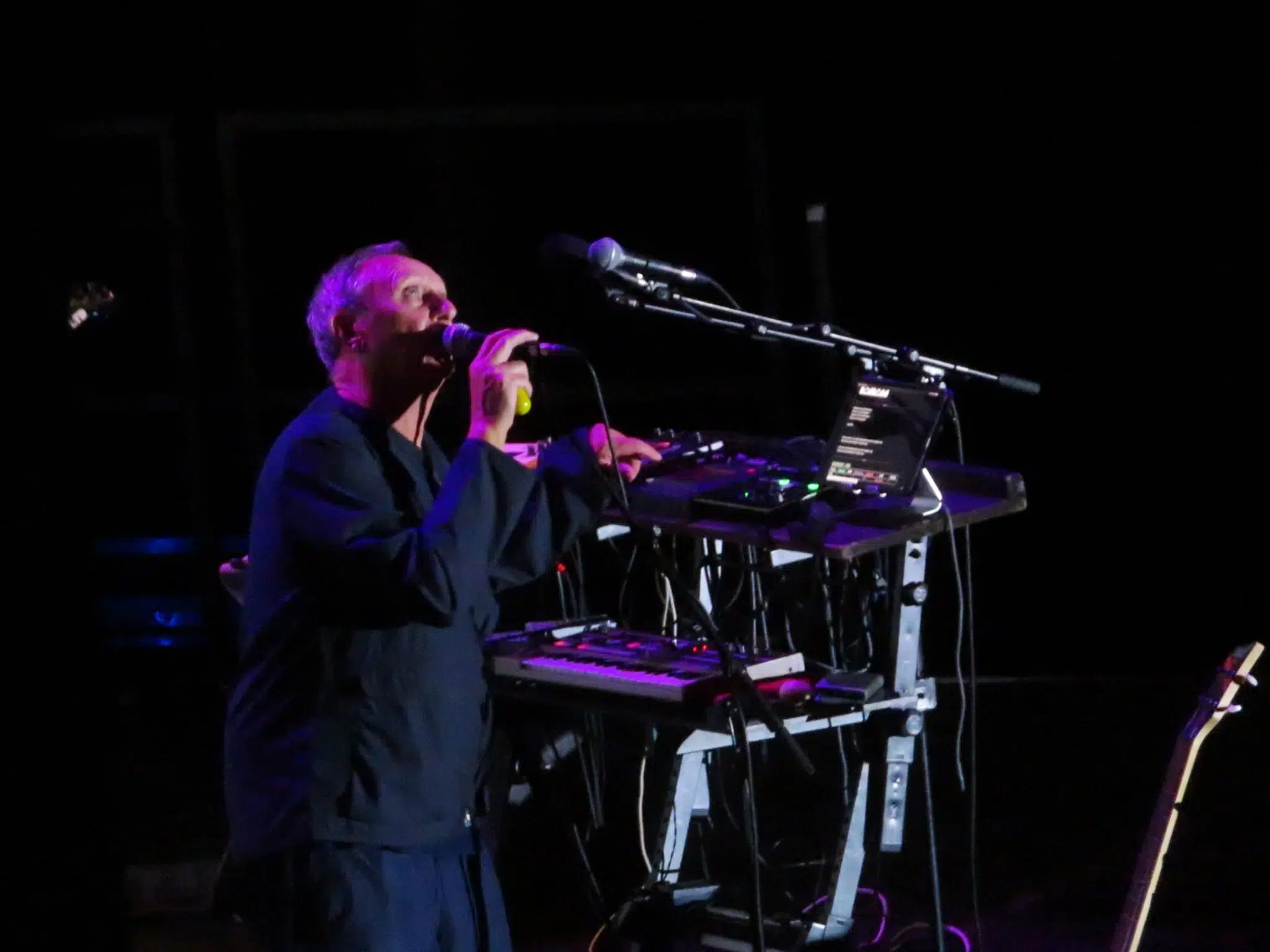
On stage in London, Benge Edwards appears in a t-shirt with a related design. Standing between Chris Watson, Stephen Mallinder, and Eric Random, it is obvious who inherited Bueller’s mantle. Drumming for Cabaret Voltaire, on their farewell lap, gives him the edge over the senior citizens on the floor at the Roundhouse.
The Cabs began their journey in 1973 – the same year The Exorcist came out. Over more than half a century of work, they have taken the audience through stages of industrial electronics, alternative dance music, electro-funk, and techno. They haven’t moved in a straight line, but each zig added something and prepared the way for the next zag. There is a case that the Sheffield set are on par with Kraftwerk, as innovators and influencers – and the body of evidence is voluminous.

Exhibit A is “24/24,” which opens the show properly. Originally written for 1983’s Crackdown album, it is menacing and funky in equal measures. Sequences tweak over an insistent bass groove while synthetic strings urge them on. The result is a (Molotov) cocktail, over which Mal half-chants his words.
That leads into a version of “Why Kill Time (When You Can Kill Yourself),” from the same long-player. Irrepressibly danceable, it helped to mark the band’s transition into mass consciousness. Watson had already left the band when their manager, Stevo, lined up a deal with Virgin. They locked themselves away in Trident with Flood for a week and emerged with an industrial-pop crossover that blended paranoia about the surveillance state with a love of Black music from America. Mal clearly feels the traces of the latter, as he starts to relax into the show.
There follows a run of early songs for those who were around at the end of the 1970s – which brings Watson’s contributions back into frame. “The Set Up,” from the Cabs’ debut EP on Rough Trade, has been transformed into something heavier through the alchemy of the alternative dancefloor. The guitar figure that scratched its way through 1978 returns as something closer to Chic than a memento from the Winter of Discontent.
“Kneel to the Boss,” from The Voice of America, is another evolved classic. It is followed by “Landslide,” the monumental instrumental from Red Mecca, and the 1980 single, “Seconds Too Late.” The end of the 70s and the opening of the 80s marked an intensely creative period for the Cabs. These tracks emerged from their Western Works studio in Sheffield as avant-garde soundscapes for a post-industrial Britain. The election of Thatcher and Reagan intensified the unease and pressure felt in working class communities, and the material reflected the growing tensions through collages of found speech and distorted sounds.
The set is broken into two by a new piece created by Watson. After he left the Cabs in 1981, taking a salaried job in television, Watson cofounded The Halfler Trio and continued his own sound experiments. He has become well known for his field recordings. “Tinsley Viaduct” has none of the pastoral passivity of the latter. It is a tribute to Sheffield that combines the clashes of machines with Krautrock’s mechanics.
The second part of the evening circles back to The Crackdown album, starting with the title track. “Just Fascination,” another (whip-)cracking single from the album appears later in the set list. “Spies in the Wires” was one of the best songs on Micro-Phonies, and it gets a solid workout; the focus of Benge’s programming being to emphasise the danceable elements of even the deepest cuts.
A cheer goes up for “Yashar,” triggered by the introductory samples from The Outer Limits television programme. This single, released on Factory (rather than Rough Trade, which had released the 2×45 album it was lifted from) marked the point at which dance music caught up with the Cabs. It was a John Robie remix that moved them from a former cutlery factory into the clubs. The live version is accompanied by the video that was released in 1983.
“Sex, Money, Freaks” and “Thank You, America” are the band’s selections to represent the Code album from 1987. The obvious choices would have been “Don’t Argue” or “Here to Go,” but they steer away from a Greatest Hits compendium.

Mal dedicates “Easy Life” to Richard H. Kirk, who passed away in 2021. The track comes from Groovy, Laidback and Nasty, the 1990 album that marked the Cabs’ transformation into a Chicago house act. The band had exercised an enormous influence in Chicago amd Detroit, and they returned the salute with an album that bore the imprint of Marshall Jefferson and American dance music. Long-time fans were confused by the pivot, but they were the times.
The main set closes with “Do Right,” which is due to return as part of the show-closer, “Sensoria.” Before we get there, the band roll out the electropunk of “Nag Nag Nag,” followed by the thunderous “I Want You” from The Covenant, The Sword, and The Arm of the Lord – an album named for a band of religious maniacs in America. Modular specialist, Finlay Shakespeare, joins the band for the encore, twisting knobs in glorious Boden red trousers.
Cabaret Voltaire’s strength lies in juxtaposition. Their weakest material is, in a sense, their purist: the acid house of “Hypnotised,” for example, which didn’t make the set list. The songs chosen for their last London show stood out by combining pop aesthetics with industrial found sound, or by incorporating Eastern tones into club 12″ singles. The return of Chris Watson to the fold helps to keep the material from becoming obvious, while Mal contributes vocal twists that add new colours to the palette.
Cabaret Voltaire have played shows in London venues since the 1970s. Their final bow at the Roadhouse is a celebration and a farewell. It is a tribute to a legacy that started in a Sheffield wasteland and covered the globe – not just the walls of Ferris Bueller’s bedroom.