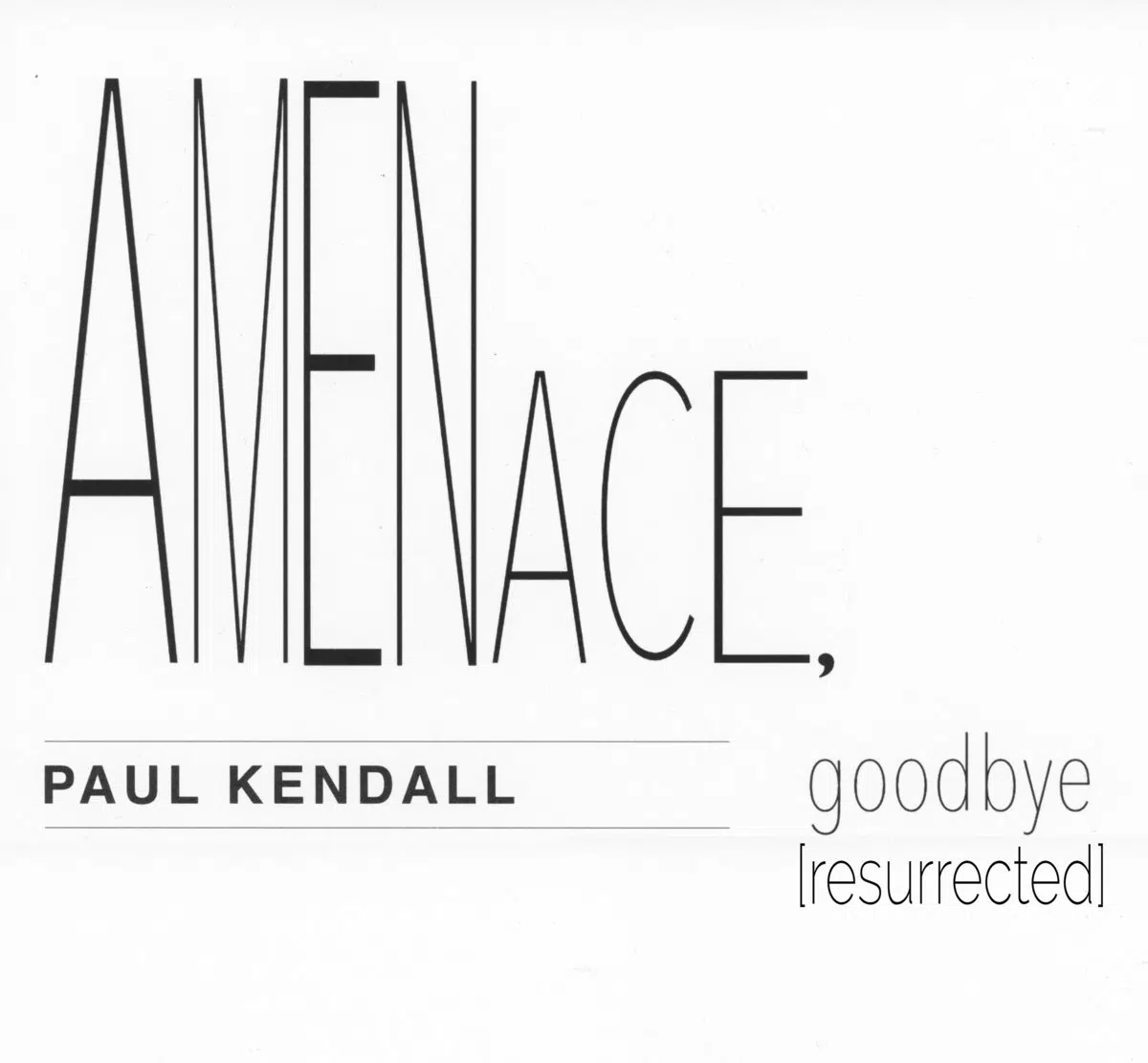
A radiator ticks as it cools. A handrail hums under a palm. Paul Kendall recorded AMENace, goodbye [resurrected] between 2023 and 2025 from sources of that kind – metal shelves, a handrail, radiators, a thermos flask and a rubber band – with a LeafAudio Microphonic Soundbox, a smidgeon of lap steel, pedals and plug-ins – and no synths. Cat Werk Imprint released the digital edition on 19 August 2026, after a vinyl pressing on Downwards, and Kendall’s sleeve notes call it the last of a series of works constructed largely inside the computer.
Very little of the source survives. By the time Kendall has stretched and squeezed the recordings, the domestic artefacts had become smears of bit-crushed grit or a loop with a limp in it. There is no voice and no melody line to follow. Rhythm does the work. Kendall builds pulses from friction and resonance, then lets them drift slightly out of step – like a washing machine walking across a kitchen floor on its spin cycle. The concrète material is the structure of each track as well as its surface, so there is no bed of synth pads to give cover to the found sounds. Much of the current industrial revival is made on modular racks and drum machines. This record gets its percussion from central heating.
Kendall’s route into tormented sounds goes back to the late 1970s. He worked in a bank for nine years; but, after his mother sadly passed in 1984, he left the job and spent a small inheritance on studio equipment. Daniel Miller then asked him to help build a similar facility for use by Mute artists. From 1985 to 1997, he was Mute’s in-house engineer, working with Depeche Mode, Wire, Nick Cave, Nitzer Ebb, I Start Counting, Barry Adamson, and Renegade Soundwave. He also set up the Parallel Series, the Mute sub-label for experimental electro-acoustic music, where he released The Faulty Caress as Piquet.
His work with Barry Adamson runs through the bassist’s early solo records. On Moss Side Story, the soundtrack to a film that was never made, Kendall is credited with production assistance and engineering. He mixed it with John Fryer. He engineered and mixed Soul Murder, which was nominated for the 1992 Mercury Prize. For Renegade Soundwave, he engineered Soundclash, the 1990 Mute debut co-produced by the band and Flood, with its tape loops, samples and dub basslines. Gary Asquith has credited part of that record’s character to the Flood and Kendall pairing.
Kendall’s series of solo releases includes Angleterror (Cat Werk Imprint, 2011), Family Value Pack (Ant-Zen, 2014), From the Penman Press(Cat Werk Imprint, 2016), and Boundary Macro. The latter used close microphones on objects the way a macro lens is used on surfaces. AMENace, goodbye [resurrected] turns the same approach on the rooms Kendall inhabits.
Hearing is part of the story. Kendall has spoken about severe frequency loss over the past decade, and about the risk that digital processing produces noise he cannot hear. That pushed him back to his early interest in musique concrète. Knowing that changes how the record sounds. Every harsh edge was checked by an ear that has to work harder than most to catch it.
Kendall’s notes locate the album within his current strategic plan:
This album marks the end of a series of objects constructed largely within the computer. My circumstances dictate that this ‘time-intensive method of creation’ is no longer feasible. It is my intention to focus on live improvisation and performance, with the computer functioning purely as an editor.
The ticks and clanks of a cooling radiator will never sound the same again.