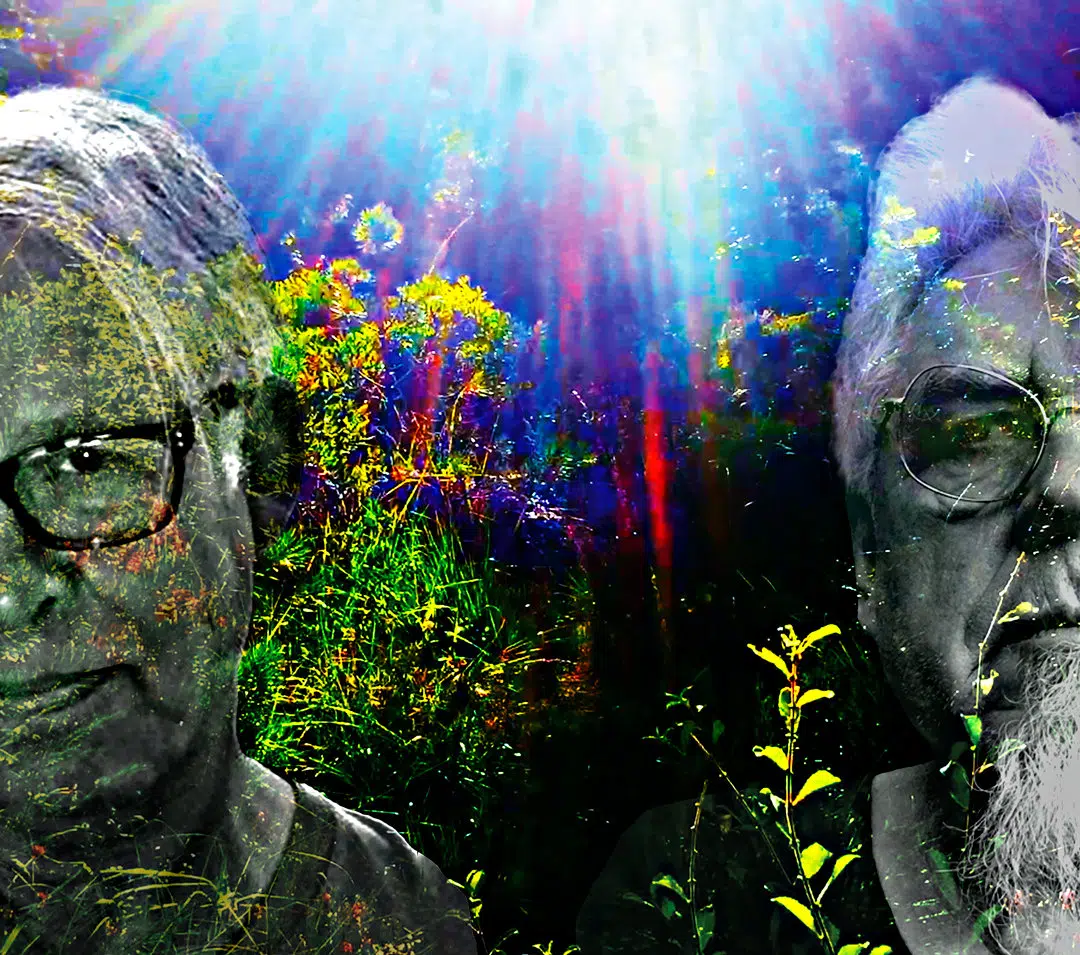
Secret Fields is the fifth album by Aerial Ship of Flowers, the Swedish duo of Karl Gasleben and Peter Davidson. Thirteen instrumental pieces reveal what the artists call “the hidden rooms between life and death, love dreams and creativity.”
Gasleben started out with Anna själv tredje and moved on to Cosmic Overdose. He remains a core and founding member of Twice a Man, the long-running Gothenburg group known for cold, painterly electronics.
Davidson has his own catalogue of ambient albums, a long list of guest spots with Swedish electronic acts, and a parallel life as a painter. The working relationship between him amd Gasleben goes back at least to 1991, when Davidson sang and played in The Butterfly Effect – a Twice a Man side project that released the album, Trip. More recently, he has been one of the voices on Gasleben & Electric Friends, alongside Anna Öberg and Karin My.
A lot of ambient music is built for the hour-long sleep stream, where nothing should start or stop. These pieces have edges. A drone sets up, a melody teases its presence, and the track closes the door behind it. Listening through feels like walking a corridor of rooms with the lights left on low, where each door opens on a different temperature.
Small, bright figures move through Secret Fields like patches of sunlight crossing an otherwise still room. Plucked notes give the music a tangible edge, while the longer tones around them soften its boundaries. A phrase briefly takes shape, then its resonance becomes part of the surrounding air.
“The Air part one” opens with sustained tones and slow movement, allowing the sound to gather. The repeating plucked figure in “September” offers something firmer to follow. Against the longer background tones, those short attacks give the ear a foothold. It builds with “Waiting,” as the work on strings becomes rhythm.
“Below the Rain” lets its low pulsation gather beneath isolated clicks and higher, lingering tones. The contrast between individual gestures and the accumulating sound becomes more pronounced. The detail draws attention – like noticing movement beyond a rain-streaked window.
“Across the Ice” draws more momentum from its quick, circling pattern. Long upper tones stretch across the repetitions, holding a different sense of time. This friction between busy phrases and sustained sound gives the music much of its appeal: there is movement within the apparent stillness.
“Freeway” arrives with more explicit electronic rhythmic support. Its firmer pulse offers a change of footing within an album so often carried by the motion of melodic fragments.
That balance takes a different shape in “Heather and Stone,” where a guitar pattern is set against slower, icy tones. Their drawn-out quality stretches the space between the more insistent notes. The ear can follow the repeating line or drift towards those longer sounds without the piece losing its centre. A little further down the track list, “Swaying Breeze” allows the phrases to linger; their resonance gradually obscuring the edges of each note.
The bright notes of “The Third Pond” bring a sharper contrast between individual strikes and the smooth tones beneath them. The title also marks a recurring landmark. It is the duo’s third track to reference a pond, following “The Pond” on Star Code Reflections and “The Second Pond” on Singing Coastlines. The titles establish a thread across the records without requiring the listener to impose any narrative.
There is something pleasingly modest about this continuing geography. A pond offers a small surface on which to watch an entire sky, and these brief, chiming phrases invite that same shift of perspective.
By “The Air part two,” the attention has returned to prolonged tones, with higher, glassy sounds above the lower drone. The two “Air” pieces give the album a loose frame; holding its smaller melodic studies between stretches of slower movement. At the close, a ringing tone is enough to hold your attention.