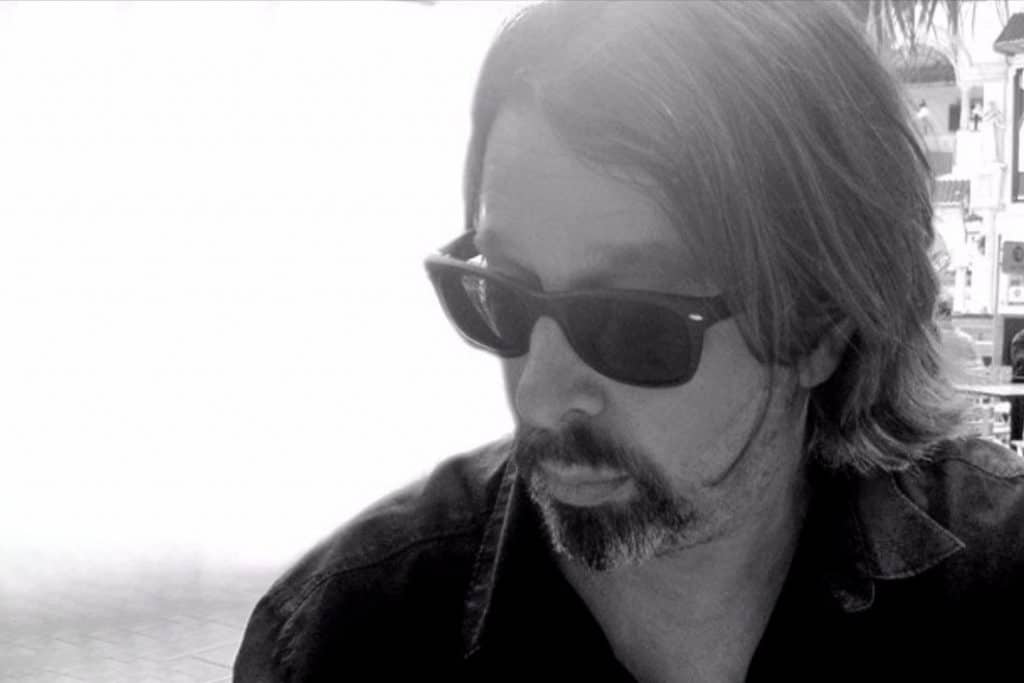
Jean-Marc Lederman has had a charmed career. He started in Brussels punk with Streets (which later became Contingent), and found his instrument in Digital Dance, the new wave band that covered Kraftwerk and opened for Joy Division at Plan K.
A stint in Fad Gadget’s first touring band followed. The London years brought a role in The The’s Marquee residency with Matt Johnson and Jim Thirlwell and midnight jams at Daniel Miller’s mother’s house on Decoy Avenue. And that was all before 1981.
Since then, the work has been mostly his own: Kid Montana; The Weathermen with Tuxedomoon’s Bruce Geduldig; Ghost & Writer with Frank Spinath (Seabound); Leatherman with Jacques Duvall; the Jean-Marc Lederman Experience records with guest vocalists; Lederman-De Meyer with the Front 242 front man; and Rohn-Lederman with Emileigh Rohn (Chiasm). He also scores films and videogames, and produced a musical iPhone app with Karl Bartos (ex-Kraftwerk). Among his other multimedia artefacts are a novel/CD written during the Covid years and Sci-Fi Revisited, a game that reveals stories read by various artists as the reward for participation.
Lederman has written a memoir, but the music industry’s unwritten rule of omerta keeps him stumm about the personalities he has worked with and the antics he has seen. What happens in the studio stays in the studio.
10. Digital Dance – Radio Activity
Digital Dance, formed in Brussels in July 1978 by Jerry WX and Stephan Barbery, added Lederman and cut a disco cover of Kraftwerk’s “Radio Activity” for Disques Vogue.
The band opened for Joy Division at Plan K in Brussels in 1979, and Lederman was charged to drive Ian Curtis and Bernard Sumner from their hotel to the venue. He never spoke with Curtis, and he admits he did not think much of the British band at the time. His ear was already in the crossover where experimental music borrows pop hooks – the zone he has worked in since.
9. Fad Gadget
Lederman and a fellow Belgian, Philippe Wauquaire (Digital Dance), became members of Fad Gadget’s line-up for a few months in 1980, after what he calls “a simple coffee cup meeting.” They played the UK, Belgium and Germany; crossing Germany in a little Honda Civic with Frank Tovey, Daniel Miller, and Chrislo Haas (DAF, Liaisons Dangereuses, Crime & the City Solution).
He was on stage the night Tovey opened his skull at the Clarendon gig and carried on in a demonstration of total performance. The Belgians were replaced by a fuller band, but they played a key role in freeing Tovey to explore the stage and truly transform into the Fad persona.
8. Kid Montana – Revisiting Yalta
Kid Montana began in 1981 as a one-man project, after the Fad Gadget appointment ended. The first recording, “Cabs Ambush,” landed on the B9 compilation on Sandwich Records in May 1981. The 1982 EP wore a wry title: Statistics Mean Nothing When You Are On The Wrong Plane.
The project grew into a duo with Dudley Kludt (Klute), and “Revisiting Yalta” came out on Antler Records in early 1984. Lederman had advertised in Melody Maker for musicians who wanted to combine Eno, Kraftwerk, and Fela Kuti – which tells you what he was aiming for.
7. The Weathermen – Old Friend Sam
The concept of The Weathermen arrived first. Lederman wondered what would have happened if the American terrorist group had made music instead of bombing things: popular culture as a route to politics, mediated through the turntable. The first 12″ single, “Old Friend Sam,” came out on Play It Again Sam.
Lederman became Jimmy-Joe Snark III, and the voice was Chuck B (in reality, Bruce Geduldig, Tuxedomoon’s visual man), singing funny, cynical words over harder electronic dance tracks. The disguises were part of the terror cell cosplay: unknown people posting finished mixes and cover art to a label that had no way to reach them.
6. Ghost & Writer – Hitman
The duo with Frank M. Spinath of Seabound formed in 2006, and the name was Spinath’s: he is Writer; Lederman is the Ghost. Their debut, Shipwrecks, ran to eight songs; each shadowed by a remix from contemporaries like File Not Found, Diskonnekted, and Acretongue. “Hitman” was the one aimed at clubs.
The pair described the songs as mean little stories blown up to cinematic proportions. Two albums followed before the project closed. The synthpop here is patient and detailed – a veteran’s hand playing with the genre’s tools.
5. Leatherman – Can’t Seem To Make You Mine
Jacques Duvall, the Belgian lyricist behind songs for Sparks, Jane Birkin and Lio’s “Banana Split,” wanted covers. Lederman wanted new songs. Leatherman, with the album Romania, went Duvall’s way. Lederman names “Falling” and “Can’t Seem To Make You Mine” as the tracks he is proudest of.
4. Jean-Marc Lederman Experience (feat. Louise Fraser) – Maybe
The Jean-Marc Lederman Experience records gave his working method its final shape: send tracks to singers he has never met and let their voices set the direction. The 13 Ghost Stories outing asked a roster of vocalists one question – how would they behave, if they could return to Earth as ghosts for 24 hours – and built an album from the answers.
The results run from dark ambient to futurepop, always with a cinematic streak, and deliberately unbothered by genre. The series began with The Last Broadcast On Earth and included Letters To Gods and The Raven – a late-career machine that keeps producing without asking permission from a scene.
3. Alain Bashung – Ode à la vie
Alain Bashung was France’s biggest rock personality. He had wanted Franz of The Young Gods as his noise maker; and, when that fell through, he tried Lederman on one song. He stayed for five on Chatterton, and a year later Bashung asked him to write.
“Ode à la vie,” composed principally by Lederman, landed on Fantaisie Militaire, an album that reached number one in France and took three Victoires in 1999.
The track is built on a rude electronic orchestration, all cold, unvarnished synth, and French critics heard a “Tomorrow Never Knows” built from programmed samples. Watching Bashung collect the awards was, Lederman says, an eerie feeling, because the record felt very close to him. It was re-recorded with Rachid Taha in 2000, and it keeps his name in the biggest company of his career.
2. Lederman-De Meyer – State of the Nation
Lederman spent a fair amount of time around Front 242 when he worked in their offices. In 2018, he collaborated with Jean-Luc De Meyer on Eleven Grinding Songs, which included this cover of the classic Fad Gadget track, State of the Nation.
1. The Weathermen – Poison
“Poison” is the one Lederman calls a pure classic – a great track then, he says, and a great track now. It sold enough records for the band to live from their music for a while, and it brought The Weathermen the attention the joke had been designed to court.
They never repeated it, and Lederman is honest about the aftermath: the chase after another “Poison” made the band unsure and hesitant. Two of their songs featured on Baywatch, which meant that the gag had been turned inside-out. Sadly, Bruce is no longer us, but the memories of Pamela Anderson running to The Weathermen are eternal.