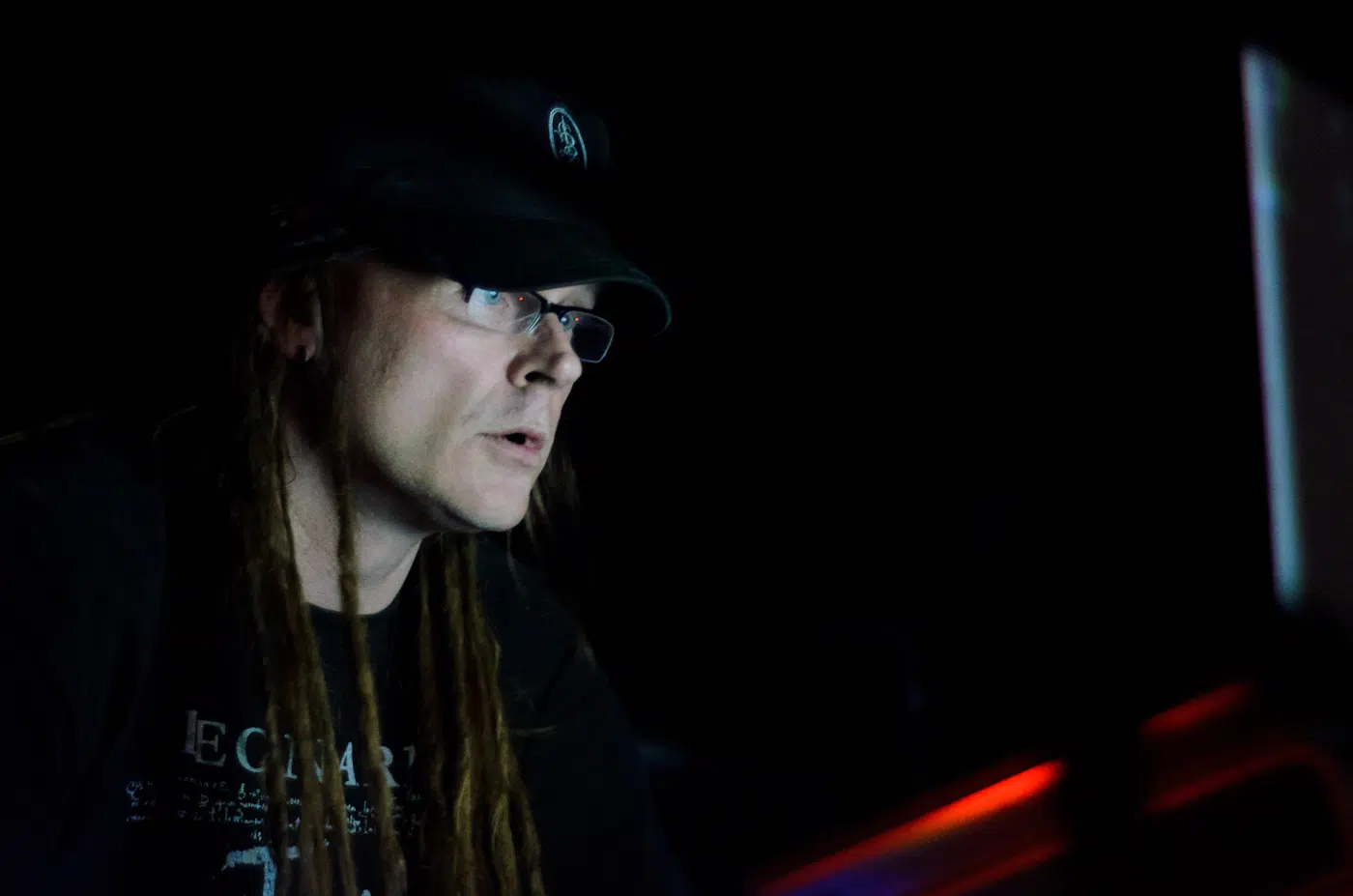
cEvin Key was born Kevin William Crompton in 1961 and made his early mark playing Simmons drums in the legendary Vancouver new wave band, Images in Vogue. He began working with another Vancouverite, Kevin Ogilvie (soon to become Nivek Ogre) in late 1982, but Key did not leave Images in Vogue until 1985. The pairing became Skinny Puppy, and Key spent the next four decades mixing melodic and hard electronics with samples from B-movies.
Skinny Puppy’s internal chemistry changed more than once. Dwayne Goettel joined in 1986, after a spell in Psyche, and brought a command of sampling that Key later credited with giving the band a new identity. Ogre left in June 1995, and Goettel died of a heroin overdose that August, closing the group’s first run. Key continued with Download, the experimental project he and Goettel had already begun together. Dave “Rave” Ogilvie moved between producer and full member depending on the record.
Key and Ogre reunited onstage in Dresden in 2000, then reformed Skinny Puppy with Mark Walk in 2003 and kept it active for two more decades. Alongside it ran a succession of collaborations: Doubting Thomas; Cyberaktif; The Tear Garden; and platEAU.
Surviving cancer surgery gave that impulse another outlet: Basal, a soft-vinyl “anti-cancer totem” developed from a sculpture he made during recovery. Toy-making became more than a diversion; he went on to develop a second toy with Simon Paul. His long-running Sunday Live Chat podcast has become another meeting point for the scene, hosting peers including Danny Carey, Graham Lewis and Mark Spybey. Through Patreon, he also runs fan remix challenges, handing over stems for supporters to dismantle and rebuild into shared releases. The audience does not always have to stay on the other side of the desk.
None of those side projects were vanity releases. Doubting Thomas offered music for imaginary films. The Tear Garden let Key write with Edward Ka-Spel of the Legendary Pink Dots. Cyberaktif reunited him with former Skinny Puppy member Bill Leeb, alongside Goettel, and brought Einstürzende Neubauten’s Blixa Bargeld into the sessions for “Paradiessiets.” Each drew on the same instinct: build the bed of sound first; then decide what voice, if any, belongs on top of it.
10. Images in Vogue – Breaking Up
“Breaking Up” appeared in 1982 as Images in Vogue’s first single. Although the band did not make an international breakthrough, its synthpop sits comfortably beside the impulses driving OMD and the Human League. Key would leave three years later, choosing Skinny Puppy and Vancouver over Images in Vogue’s planned move to Toronto.
The single showcases a working drummer inside a tightly-organised pop arrangement. Key’s electronic experiments would develop alongside that work, rather than waiting for it to end. The contrast is between two uses of discipline; not a sudden conversion from drums to machines.
9. Skinny Puppy – Dig It
“Dig It,” from 1986’s Mind: The Perpetual Intercourse, was Skinny Puppy’s first single. Key and Dave Ogilvie produced and engineered it, while Goettel’s contribution received the wonderfully evasive credit, “gadgetry.”
Built around a sample from the Twilight Zone episode, “Elegy,” and Ogre’s refrain about an “economic slave,” it became the song Trent Reznor later named as the direct spark for Nine Inch Nails’ “Down in It.” Its own video, which Key recalled MuchMusic banning over supposed subliminal messaging in the letterboxing bars, was arguably the smaller controversy.
8. The Tear Garden – You and Me and Rainbows
After exchanging letters with Edward Ka-Spel, Key worked the sound desk for his North American solo shows and began recording with him in January 1986. “You and Me and Rainbows,” a six-part, near-seventeen-minute piece from 1987’s Tired Eyes Slowly Burning, brings in Goettel on keyboards, Rave on guitar and tapes, Lee Salford on drums, and Ogre and Lisa on additional voices.
The scale gives Key’s rhythm sense room to meet Ka-Spel’s wandering vocal without having to contain it. Ogre’s intervention briefly brings the familiar menace back into view, but it is one episode in a much larger piece. It serves as evidence that Key’s writing had a register beyond Skinny Puppy’s electro-industrial confrontations.
7. Skinny Puppy – Testure
“Testure,” from 1988’s VIVIsectVI, is a dancefloor record that doesn’t compromise its subject matter: a case against animal experimentation built on smooth electronics and bass; offering a moment of relief between harsher tracks. Key shared production duties with Dave Ogilvie, while the fretless bass came from Dale Plevin.
Released as a single in 1989, it reached No. 19 on Billboard’s Hot Dance Music/Club Play chart – the band’s only entry. Samples from The Plague Dogs run through “Testure.” The track proves the band could make an argument and a groove out of the same five minutes.
6. Skinny Puppy – Worlock
“Worlock,” lifted from Rabies and released as a single in 1990, is built on a vocal sample of Charles Manson singing over a fragment of the Beatles’ “Helter Skelter” guitar, spliced against sirens, spoken dialogue, and a chorus voice processed until it curdles. Ogre called it one of the band’s better songs, but its horror-film collage video attacked censorship and was banned by MTV.
The track sits at the centre of every argument about what cEvin Key actually does. Doubting Thomas made music for imaginary films. Scaremeister, his later collaboration with Ken Marshall and Traz Damji, supplied real film trailers. “Worlock” collapses the distance between soundtrack and song, turning a killer’s own recorded voice into raw material for a dance record.
5. Skinny Puppy – Spasmolytic
“Spasmolytic,” the second single from 1990’s Too Dark Park, arrived with a Jim Van Bebber-directed video circulated to clubs and video shows. Key and Dave Ogilvie produced, with Key credited on drums, synthesizers, guitars ,and sampling across the album.
Where Rabies leaned on Al Jourgensen’s Ministry-adjacent grind, Too Dark Park pulled back towards a chaotic, sample-thick sound. “Spasmolytic” is the single that shows the shift most clearly: dense, danceable, and driven by the friction between the band’s moving parts rather than a guest producer’s signature.
4. Doubting Thomas – Father Don’t Cry
Key and Goettel recorded the original Doubting Thomas material between 1987 and 1990, building music that suggested soundtracks for films never shot. “Father Don’t Cry” appeared on 1991’s The Infidel and, in an extended version, led the accompanying EP, recorded at Vancouver Studios in 1990.
Stripped of Ogre’s voice, the track runs on mood and implied narrative, rather than conventional song structure – it is closer to a film cue than a single. It is the plainest demonstration of how much of Skinny Puppy’s atmosphere came from Key and Goettel’s instincts rather than from anything sung over them.
3. Cyberaktif – Nothing Stays
Cyberaktif reunited Key with Bill Leeb, who had left Skinny Puppy to start Front Line Assembly, and brought Goettel into the collaboration. “Nothing Stays,” engineered and mixed by Key and co-produced with Leeb for 1991’s Tenebrae Vision, was later ranked sixteenth in COMA Music Magazine’s 101 greatest industrial songs.
Key described the project as revisiting the tape-trading enthusiasm its musicians started with. The track carries a leaner, more straightforwardly danceable EBM pulse than Skinny Puppy generally allowed itself – built by collaborators who already knew each other’s shorthand.
2. Download – Marred
Dwayne Goettel co-wrote “Marred,” a nine-minute piece on Download’s 1995 debut Furnace, alongside Key, Genesis P-Orridge, Mark Spybey and Phil Western. The album was recorded between May and July and released with a dedication to Goettel after his death on 23 August.
Download began as a collaboration with Goettel, and Key continued it after the loss. “Marred” is not a memorial conceived after the event, but a piece of shared work that outlived one of its makers, with P-Orridge’s vocal giving the electronics a distinctly human unease.
1. Skinny Puppy – Use Less
“Use Less,” from The Greater Wrong of the Right, brought Danny Carey of Tool in on acoustic drums and Wayne Static of Static-X on a second vocal, within an album collectively composed and arranged by Ogre, Key and Mark Walk and co-produced by Key and Walk. Static was no stranger to this language: Skinny Puppy was among the influences that had shaped his own music.
It is an unlikely choice on paper: a comparatively melodic track on the band’s most accessible album. But it answers the question every other entry on this list raises from a different angle: whether the person assembling samples, drum patterns and other people’s voices into Skinny Puppy’s sound for twenty years still had anything left to organise. “Use Less” says he did.