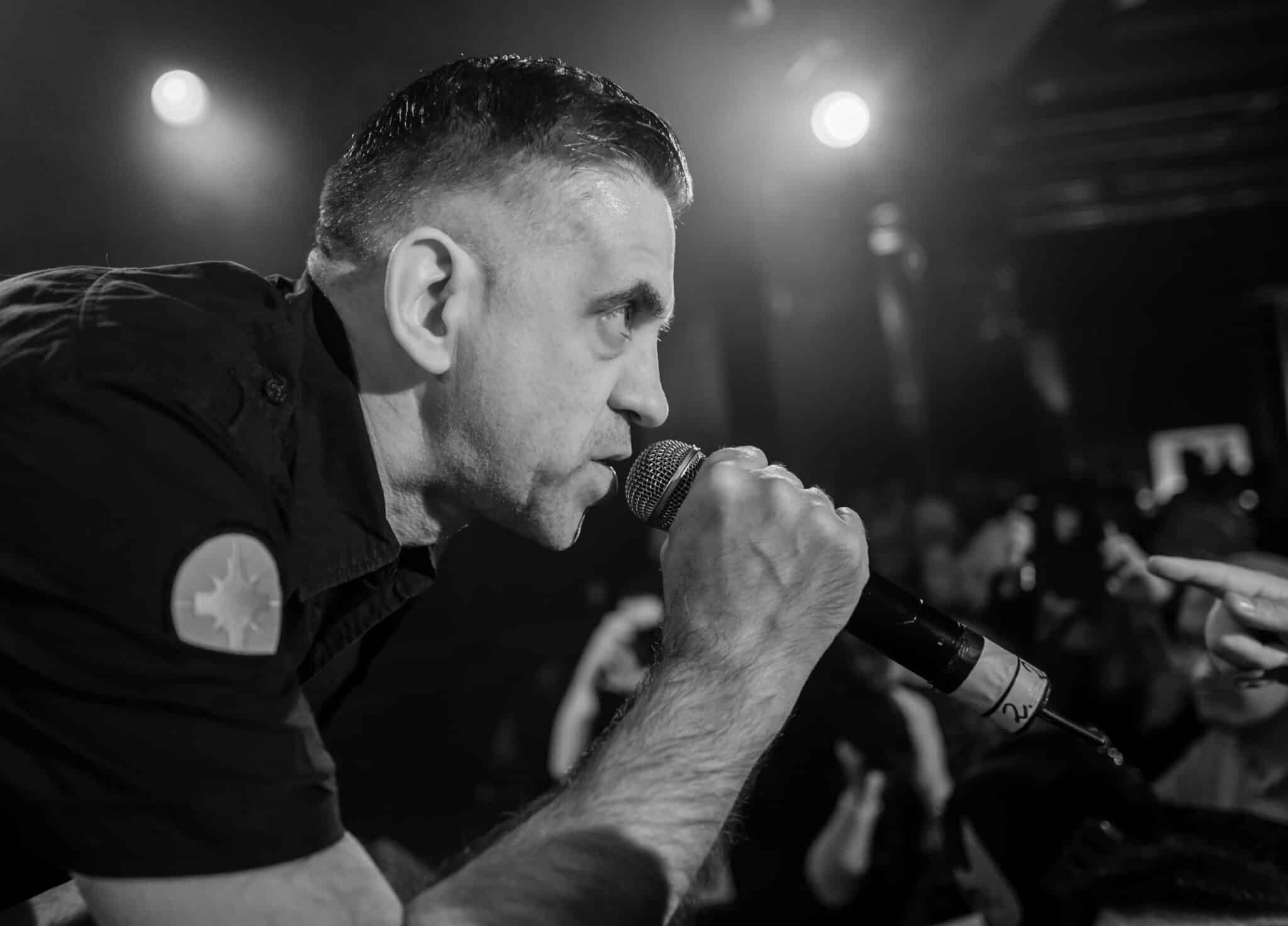
Portion Control emerged from a South London catering college armed with synthesisers, drum machines, and shocking visuals, instead of spatulas, scales, and whisks. Rather than riffs on French sauces, they created experimental and aggressive music that served as one of the main sources for the emerging electro-industrial and electronic body music (EBM) genres. Tracks like “Refugee,” “The Great Divide,” and “Under the Skin” delivered pointed, hardened electronics with shouted vocals, providing the template for bands like Nitzer Ebb, and inspiring Skinny Puppy and Front Line Assembly. More eccentric material, such as “He Is a Barbarian,” showed a free-flowing creativity that was unleashed by the availability of cheap keyboards and a total lack of inhibition.

Fans of the band, which has survived for more than four decades (with some very lengthy breaks) have several ways to collect the artefacts of their creative genius. The first compilation was issued by their label, In Phaze, in 1983. The Man Who Did Backward Somersaults, a CD selection, appeared a decade later on another British label. Until now, the definitive set was released by the band as a multi-CD box set called Archive in 2006, which covered their early vinyl releases and helpfully included MP3 versions for transferring to players. The German label, Vinyl-on-Demand took a different approach with Progress Report 1980-1983, a seven-LP metal box devoted largely to the cassette years, with a book, DVD and material from Gaining Momentum, Private Illusions, I Staggered Mentally and the group’s own tape archive. That was followed by Progress Report 1982-86, which appeared within the label’s 80’s Minimal.Synth.Wave Volume III box in 2015.
1983-86 – Hit The Pulse to Purge… is the result of the band’s new deal with Canada’s Artoffact Records. Served as a four-CD set, it draws on much of the material from previous compilations, while sweetening the deal with some rarities and remixes (or rebuilds) by Rhys Fulber that appear on CD for the first time.
The collection begins with Hit The Pulse. “Chew You to Bits” forces a clipped vocal through a sequence that seems to tighten each time it returns, while “Crash Weight Gain” and “Abbo Dabbo” make economy sound aggressive. The remaster by Paul Lavigne at Kontrast Mastering gives their edges definition but does not separate elements that were designed to rub against one another.
..Step Forward broadens the space. “Refugee” carries a nervous electro-funk current, “Under the Skin” makes repetition feel invasive, and “Havoc Man” stretches the group’s rhythmic pressure without relaxing it. By Psycho Bod Saves the World, the sequences are heavier and the fragments of speech, noise and melody have become more densely packed. “Brain Scraper Death Dive” and “H.O.T. Matter” are not prototypes for somebody else’s EBM. They are stranger constructions, full of hard surfaces and sudden gaps.
The singles show how well Portion Control understood the value of the extended mix. “Raise the Pulse,” “Go-Talk” and “The Great Divide” do not merely run longer – they use the additional space to alter the balance between voice and rhythm. The Purge versions are particularly effective: familiar components return with different stresses, as if the songs have been dismantled and put back together under poor lighting.
What Artoffact adds is focus and availability. The actual Bandcamp track list runs to 77 tracks, despite older promotional text on the same page still saying 74 were expected. Sixteen are described as previously unreleased and another twelve as appearing on CD and digitally for the first time, although the label has not identified which titles belong to each category. The set also provides a new remaster, six demos, several rebuilds, two substantial live sequences, and a 24-page booklet designed by Stefan Alt.
The demos are useful because they expose construction rather than merely supplying inferior versions. Two attempts at “H.O.T. Matter” test the distribution of force before the released arrangement fixes it in place. “Scramble,” without its finished surface, reveals how much of Portion Control’s character lies in timing: a sound enters fractionally early, another hangs on too long, and the groove develops a reticence that becomes propulsion.
The concerts reveal the heaviness of Portion Control in full flight. Amsterdam is tense and compact, with “Eat Your Heart” and “Crash Weight Gain” striking faster than their studio counterparts. The 1985 Lausanne recording is broader and more assured. “Real Estate Cult,” “Havoc Man” and “Bolt It Down” are driven by sequences, but the performances never feel automated. The machinery provides discipline; the voices and percussion push against it.
Rhys Fulber’s rebuild of “Refugee” moves its electro-funk skeleton towards breakbeats without disguising the original’s unease. “Displaced Hybrid Refugee” takes a harsher route. These additions sit outside the historical sequence, but they demonstrate that the archive is still being handled as living material rather than displayed as a relic.
Hit The Pulse to Purge… does not replace the earlier boxes. Archive contains a wider first-period survey, while the Vinyl-on-Demand editions preserve cassette material, video and several 1982–86 rarities absent here. Artoffact offers the clearest route through Portion Control’s decisive middle period: better distributed, newly mastered, and arranged to show how unstable experiments acquired muscle without becoming orderly. The pulse is preserved. So is the danger.