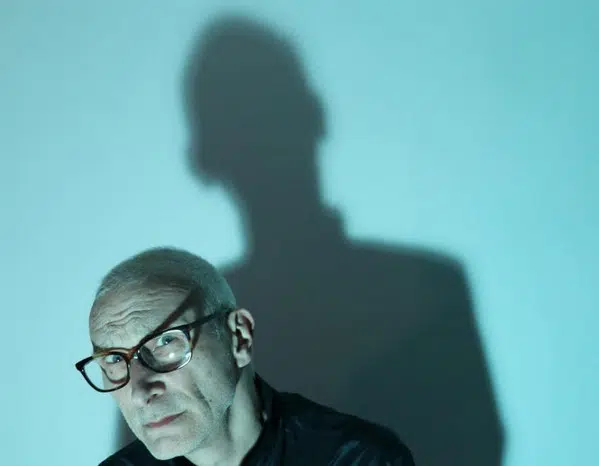
Paul Kendall has been moving through British music history since the late 1970s, quietly altering its signal path. He was a member of a post-punk band, Dry Rib, before an inheritance provided the means to build a home studio and reproduce the sonic experiments of Pierre Shaeffer and Karlheinz Stockhausen.
A critical step came when his then-wife, Joni Sackett, got a gig doing backing vocals for Gag-era Fad Gadget. That brought him into Daniel Miller‘s world, and the pair bonded over a shared appreciation for obscure electroacoustic music. Kendall became one of Mute Records’ go-to engineers, working with artists like Wire, Bruce Gilbert, and Frank Tovey. He also acquired responsibility for assembling Mute’s in-house studio facilities.
Kendall’s production and engineering contributions have helped to shape the sound of the Mute “family” since the first half of the 1980s: producing I Start Counting’s debut; co‑producing Wire’s reinvention; becoming Alan Wilder’s long‑term foil in Recoil; and slipping his own, more radical, work out via the Parallel Series (a Mute sub-label) as Piquet and in collaborations like Gilbert Hampson Kendall. He works more in the shadows than the spotlight; but, once you start to listen, you can hear his presence across the catalogue.
10. I Start Counting – Catch That Look
I Start Counting, the duo of Simon Leonard and Dave Baker, took its name from a genre-mashing film about a besotted Jenny Agutter and a Berkshire serial killer. The film’s quirkiness and coming-of-age romantic drama are reflected in the act’s sublime minor-key pop.
With Baker’s plaintive vocals, fumbled boy-girl stories, and experimental electronics, they were the counter to Depeche Mode’s “pain and suffering in various tempos.” If there was such a thing as pop justice, I Start Counting would have been as big as their label-mates, but they were slightly out of step with the commercial market.
Kendall was nominated by Daniel Miller to produce the act’s first album, My Translucent Hands. The mood on “Catch That Look” is pure I Start Counting: a tidy drum machine; detuned synths; and deadpan vocals. The arrangement is simple on paper – no virtuoso playing, no big dynamic swings – but the recording and mix make every small decision feel loaded. The rhythm is crisp without ever becoming aggressive; and there’s enough air around each part that a tiny change in tone or level immediately registers.
9. Wire – In Every City
Wire’s late‑80s phase coincided with Kendall moving into a co‑producer/engineer role on It’s Beginning To And Back Again. He returned to steer the DUGGA epic, The Drill, in 1991, which opened with a surprisingly bovine roar.
“In Every City” is mixed by Kendall with (cow?) bells echoing and guitars sweeping the stereo field. The song glides as much as it stomps: lithe rhythms; vocal interplay between Colin Newman and Graham Lewis; and guitar gestures shaved down to aerodynamic shapes rather than riffs.
The mix chops and slices an emerging sleekness into something slightly menacing. Vocals sit in an ambiguous space – not entirely natural, not ostentatiously processed – and Kendall’s occasional pushes of reverb or doubling make them feel as if they’re slipping between locations. The city in the lyrics never quite comes into focus, and the sound mirrors that: a network of surfaces and reflections where you’re never certain what’s solid. It’s a perfect document of the period when Wire decided to live inside the studio’s signal path, and Kendall was the one fine‑tuning the thermostat.
8. Piquet – Remains
“No sound is dead sound,” say the liner notes on The Faulty Caress. Released as a Parallel Series offering under the nom de guerre, Piquet (P.K. – geddit?), the album explores the capabilities of the studio and Kendall’s Pro Tools rig.
“Remains,” the closing track, arrives after nearly an hour of carefully constructed tension – and it does not release it so much as let it settle. Where the album’s earlier movements push and probe, this is what is left when the motion stops: a slow dissolve of texture and atmosphere. It is the kind of track that makes you unsure whether the music has ended or simply become the room. The piece retains a physical clarity that keeps it from drifting into mere ambience. Kendall understood that an ending is its own argument. This one is quite convincing.
7. Die Krupps and Nitzer Ebb – Machineries of Joy (True Work Mix)
By 1989, Die Krupps had spent the better part of a decade hammering Düsseldorf’s industrial heritage into something you could actually dance to. “Machineries of Joy” was the thesis statement, but it was the “True Work Mix” that proved the argument.
The song had already appeared on Wahre Arbeit, Wahrer Lohn in rawer form. Enter Kendall, together with Nitzer Ebb. They pushed the track towards something rawer and more hydraulic. The sequencers were tightened. Bass pulses stopped functioning as accompaniment and started functioning as instructions. This is where the descendents of Gabi and Robert came together to compare their DNA: that same stripped-down body music philosophy, raised in Essex as firmly as the Rhineland.
What the “True Work Mix” strips away is exactly what makes it land harder. Less texture, more pressure – it wasn’t designed for radio. No, it was built for concrete floors at three in the morning, where the line between dancing and laboring has always been thinner than it looks.
6. Gilbert Hampson Kendall – “Quad”
Orr – credited to Gilbert Hampson Kendall – is one of its strangest, most revealing rooms in the Mute office complex. “Quad” is all wiring and walls; entirely stripped of furnishings. There are no verses, no choruses, no backbeat to hang onto. Instead, you get fields of sound: treated guitar residue; low‑frequency currents that feel like air‑conditioning ducts; high squeaks and buzzes that might be digital artefacts or carefully curated instrumentation.
What stops it feeling like a technical exercise is the way it moves. Kendall’s long experience organising other people’s chaos into album form shows in the pacing. Motifs recur in altered forms: a noise that first flickers in one corner of the stereo image reappears minutes later; transformed but recognisable, in another. Densities rise and fall as if someone is opening and closing doors down a corridor. The piece never offers catharsis, but it never stops thinking either. “Quad” sounds like the studio’s interior monologue – the by‑product of a man who has spent years listening to what happens when you leave machines alone.
5. Recoil – Jezebel
Recoil, Alan Wilder’s project after his departure from Depeche Mode, gave Kendall an ideal canvas. No live band to service; no need for stadium‑friendly structures – just a studio treated as cinema. “Jezebel” builds on blocks of blues-rock and reverb. The groove is like urgent trip-hop, and the atmosphere is voodoo-level creepy.
Kendall’s contribution is most obvious in how the piece uses space as narrative. Sounds don’t simply sit left or right, loud or quiet – they move between positions in ways that mirror emotional shifts. The tracks are filled with whispers that blend with reversed strings and mesh with gospel flourishes in a brutal incantation.
4. Nitzer Ebb – Lightning Man (The Industry vs The Ebb Mix)
Nitzer Ebb’s music is often remembered as pure blunt force, but tracks like “Lightning Man” reveal how much that energy depends on intelligent framing. Kendall worked with the band in the early 90s as mixer and live sound collaborator, and you can hear his sensibility in the way their severe EBM minimalism is turned into something that hits hard without collapsing into noise. The beat is brutally simple – kicks, snares, a few disciplined fills – yet the sound design is anything but crude. Kendall worked with Miller on this remix, and the results are commercially satisfying while maintaining an experimental edge.
3. The Digital Intervention – Capture
After relocating to France at the turn of the century, Kendall extended his Parallel Series work via The Digital Intervention, a project with vocalist and composer Olivia Louvel. The title track of Capture feels like a bridge between Kendall’s more austere electroacoustic pieces and his song‑centred Mute history. Louvel’s voice sits at the centre: clear and intimate; switching between sung and spoken; but never overwhelmed by the surrounding electronics.
Those electronics are spare and glassy. Beats tick rather than slam. Pads are thin and translucent. Glitches thread through the frequencies. Kendall uses that restraint to turn production into psychology. Louvel appears in multiple “states:” dry and close; doubled and spectral; distant and reverberant. It feels less like conventional vocal work and more like a model of thought: what is said; what is heard; what echoes internally. The track never raises its voice, but the engineering keeps the listener slightly unsettled – aware that what seems like a simple performance is in fact a layered construction. Arguably, that’s been Kendall’s point all along.
2. Frank Tovey – The Liberty Tree
Frank Tovey‘s withdrawal from his Fad Gadget persona coincided with his search for a more human and involved approach to music-making. It saw him move through American protest music and folk to make a connection with the Irish band, The Pyros. Tovey, who made his name as a performance artist tapping on a synthesiser in a cupboard, was looking for a form to suit his critical and more lyrical messages.
Kendall teamed up with Tovey for Grand Union, an album that coalesced around a series of links to the canal running behind Mute’s Harrow Road offices. “The Liberty Tree” was the obvious choice for a single, and Kendall gave the recording a directness and atmosphere suitable for a love song about rebellion.
1. PK – Family Value Pack
Family Value Pack, released under the PK moniker, is Kendall’s late‑career solo statement – a record that folds decades of studio practice back into itself. Here, the man who usually stays behind the glass steps out with his own material, but he doesn’t suddenly turn singer‑songwriter. Instead, the title piece (and the album around it) treats the track form itself as something to be probed. You get rhythms that flirt with pattern and then break, tones that suggest harmony and then drift, voices and samples that hint at narratives and then cut out mid‑scene.
The sound is deliberately out of sync with contemporary gloss. There’s no rush to fill every frequency band or push everything to the front. Instead, Kendall relies on contrast and perspective. Very quiet passages make brief intrusions feel enormous, while brutally dry sounds are suddenly dropped into deep digital space. In a way, it’s the logical endpoint of everything else here: the Mute studio builder and Recoil co‑conspirator turning his techniques inwards, using the same care he once lavished on other people’s work to question what a “finished” piece even is.