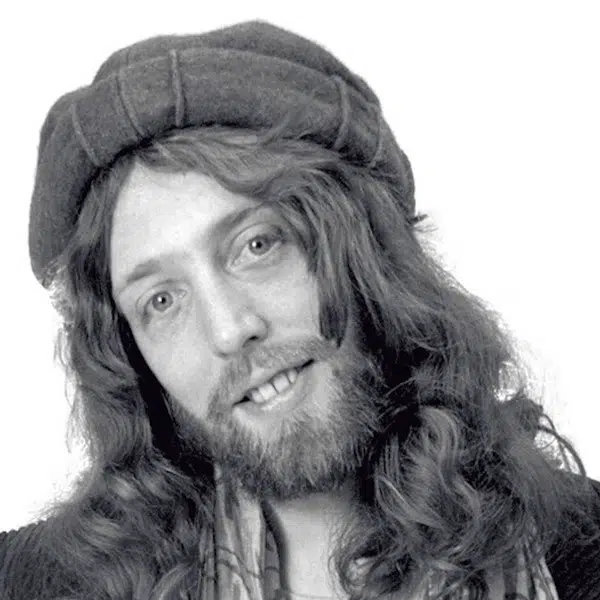
Steve Hillage has made a career finding the spaces within beats and turning rhythms into textures that envelop the listener. As a member of Gong, he was key to the development of progressive rock in the UK, but his solo works and third party productions have revealed a distinctive talent for pop, dub, techno, Goa trance, and world music. Blending styles and applying his techniques as a guitarist have yielded sounds as diverse as Simple Minds’ “Love Song” and The Orb’s “Blue Room.”
Born in Chingford in 1951, Hillage formed Uriel with Dave Stewart, Mont Campbell and Clive Brooks while at school. He left to study history and philosophy at the University of Kent, then returned to London to form Khan, whose sole album, Space Shanty, appeared in 1972. After working with Kevin Ayers, he joined Gong in January 1973, appeared throughout the group’s Radio Gnome Invisible trilogy, and met his long-term partner and collaborator Miquette Giraudy.
Hillage began his solo career while still in Gong, recording Fish Rising with several of his bandmates. Albums including L, Motivation Radio and Green followed, combining progressive rock with synthesisers, funk, dub and increasingly elaborate studio processing. By the end of the 1970s, fatigue with touring and doubts about the role of the guitar hero led him towards production work.
His clients were not obvious fellow-travellers: Simple Minds, Nash the Slash, Robyn Hitchcock, Real Life, and Cock Robin were among his high-profile assignments. Although closely associated in the popular imagination with prog music, Hillage was close to synthesisers and electronic sounds from early days. He started to work to a drum-machine click after reading about Parliament and Funkadelic’s methods. He dates an important revelation to hearing Kraftwerk in a Plymouth club in 1978.
Hillage turned more firmly towards techno and trance at the end of the 1980s with System 7, followed by chill-out ambient electronics with Mirror System and collaborations with The Orb. This move was not forced by the hand of chance: finding ways to induce alpha-waves through music is consistent with his interest in psychedelic sounds and experiences. Armed with a copy of Pro Tools and a talent for creating guitar riffs that keep pace with any sequencer, he has become one of the most respected creators of alternative dance music – a long way from the Canterbury Scene.
10. Nik Turner’s Sphynx – The Awakening (Life on Venus)
Hawkweed’s Nik Turner recorded flute improvisations in the King’s Chamber of the Great Pyramid, using the natural resonance of the space to create atmosphere. Hillage took the tapes to Los Angeles for pre-production before a loose group, including his partner, Miquette Giraudy, Mike Howlett, and Tim Blake, gathered to develop them at Rockfield. He produced Xitintoday as “Stiv Hillage” and played gliss guitar on its opening track.
“The Awakening (Life on Venus)” transformed a resonant artifact into the beginning of an album. Turner’s flute drifts through Giraudy and Blake’s synthesisers, Harry Williamson’s backwards piano, and Hillage’s guitar without being tidied into a conventional lead instrument. The production preserves the chamber’s air – creating a dance from archeology.
9. Cock Robin – The Promise You Made
Hillage produced Cock Robin’s first album; sharing the recording credit with Gabe Veltri, and mixing everything except “When Your Heart Is Weak.” He later called it a long, high-pressure project that taught him how to interact creatively with artists under strain.
Peter Kingsbery and Anna LaCazio alternate lines rather than merging into a comfortable duet on this track. The production keeps the verses open, then allows the chorus to widen around them.
8. Gong – Master Builder
Gong provided Hillage’s studio education. He has described a method of jamming, making rough tapes, extracting promising passages,and developing them: improvisation made editable. “Master Builder” carries a ten-member writing credit, with Hillage as the lead guitarist.
The track locks onto a repeated figure and refuses to loosen its grip. Bass and percussion build a rotating frame with Tim Blake’s Moog, EMS synthesiser and Mellotron, while Hillage’s guitar changes pressure above it. He later returned to the pattern as “The Glorious Om Riff” on Green. The useful lesson is structural: repetition creates movement when the sound around it keeps shifting.
7. Real Life – Catch Me I’m Falling
Ross Cockle produced Real Life’s “Send Me an Angel” before Hillage took on most of the debut album. He subsequently remixed that song and “Openhearted”, and produced the remaining tracks on Heartland, including “Catch Me I’m Falling.”
An urgent bass sequence, glassy keyboards, and David Sterry’s anxious vocal occupy distinct layers, even when the chorus reaches full width. Hillage gives the electronics a bright surface but leaves enough weight underneath. The chorus arrives fully loaded without allowing the sequence to buckle.
6. The Orb – Blue Room
Hillage described The Orb as a partner project and recalled that “Blue Room” began in the London flat he shared with Giraudy. The release credits him as co-producer and guitarist, with Jah Wobble on bass and The Orb handling the mix. Hillage says the 39-minute, 57-second version would have been impossible without Digidesign’s Sound Tools.
Wobble’s bass moves through a field of voices, signals, and suspended rhythm. Hillage’s guitar appears as a distant flare rather than a rock solo, then disappears back into the mix. The extended duration allows sounds to enter and leave without disturbing the pulse. This makes the point at which dance music has begun to redefine what his instrument can do.
5. Nash the Slash – Children of the Night
Nash the Slash made Children of the Night with electric mandolins, electric violins, electronic percussion, keyboards, pedals, voices and devices. The sleeve was emphatic about the absence of guitars. Hillage produced the sessions at Britannia Row – Pink Floyd’s Islington Studio, where New Order later recorded “Blue Monday” – in November 1980. The Virgin sublabel, Dindisc, and Nash’s Cut-Throat Productions issued the album the following year.
The title track begins with an ambient opening before the rhythm asserts itself. Bowed strings scrape against the sequencer while Nash’s voice maintains its masked distance. Hillage makes the unusual instrumentation intelligible without normalising it. The result is gothic electronic pop with its wiring exposed.
4. Steve Hillage – Ether Ships
Hillage and Pink Floyd’s Nick Mason co-produced his solo album, Green, with John Wood engineering. Hillage played guitar, Moog and guitar synthesiser, while Giraudy supplied ARP and EMS synthesisers and vocoder. Hillage used a Roland GR500 guitar synthesiser on the album, extending notes by feeding a square-wave oscillator into the instrument’s fuzz circuit as the guitar decayed.
A sequencer establishes the track’s line of travel. Guitar enters in long, bright curves before it takes on a firmer body. Hillage has called “Ether Ships” the first System 7 track. Its electronics do not replace the band format – they alter its gravity.
3. System 7 – Rite of Spring
System 7 took shape as a collective around Hillage and Giraudy in 1989. By 1997, it had been refined to the core duo. The Golden Section album, released that year, showed the act extending its range into breakbeats and drum and bass without abandoning its house and techno base. “Rite of Spring” opened the album and appeared as its first single.
The opening rhythm swishes rather than strikes. A clear synthesiser motif hangs above it as the groove gathers force, joined by acid lines that never displace the hook. With System 7, Hillage is no longer bringing a guitar into somebody else’s dance record. With Giraudy, he has built a production language in which melody, electronics and physical momentum are already indivisible.
2. Rachid Taha – Barra Barra
By Made in Medina, Hillage and Taha had developed a shared language. On “Barra Barra”, Hillage produced and mixed, shared the writing credit with Taha, played lead and rhythm guitar, programmed and contributed to the string arrangements.
The track begins with hand percussion before heavy beats and rough guitar enter the frame. Taha’s vocal pushes through the arrangement rather than sitting above it. Hillage later described the method developed with Taha as a fresh combination of programming and live instruments.
1. Simple Minds – Theme for Great Cities
Simple Minds recorded Sons and Fascination and its companion, Sister Feelings Call, with Hillage in 1981. Hillage recalls Neu!, Can and Kraftwerk as common ground, with Michael Rother’s Katzenmusik playing in the studio. He credits Mick MacNeil with pioneering work using sequencers and arpeggiators. “Theme for Great Cities” began as an instrumental, ready for Jim Kerr to add vocals, but Kerr claims his own ideas didn’t live up to keeping the track as it was.
The bass line advances with complete assurance. Brian McGee’s drums create motion without haste, while MacNeil’s keyboards open the horizon and Charlie Burchill’s guitar marks the air above it. Hillage’s production gives every part distance and purpose.