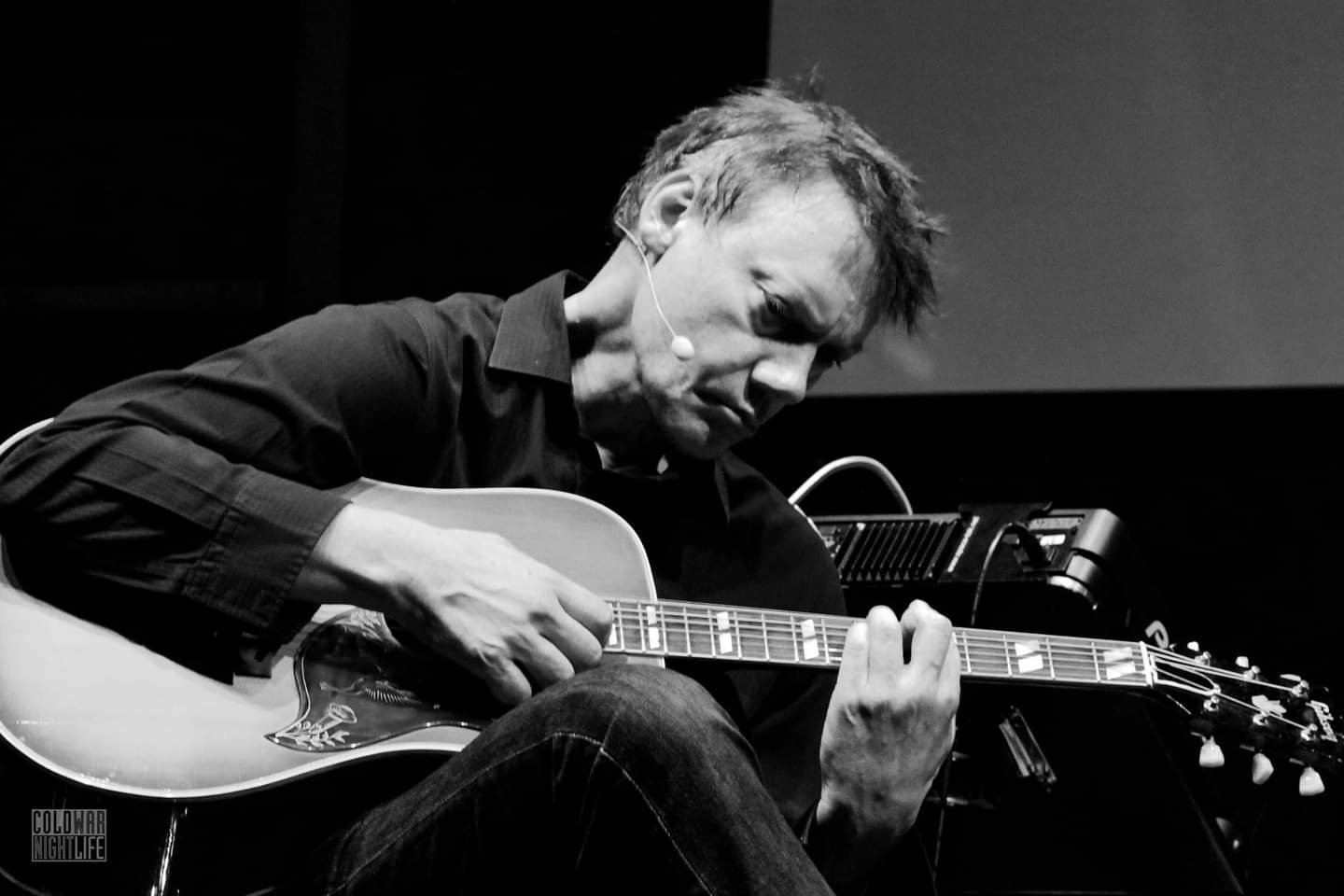
William Orbit has died, aged 69. He passed away at home on 23 July 2026, his family and friends have confirmed. No cause of death has been disclosed.
There are producers who make records sound expensive, and producers who alter the air around them. Orbit belonged firmly to the latter group. His work changed the emotional temperature of electronic pop. It made space for silence, suspension, grain, afterglow and doubt. He made synthesisers feel intimate without making them small. He was sought out for his signature sound and remix talents by Kraftwerk, Nitzer Ebb, Erasure, S’Express, Malcolm McLaren, and a host of alternative and mainstream acts.
Born William Mark Wainwright in London’s East End, Orbit taught himself guitar as a teenager and first tried a synthesiser at 16. From a Harrow Road squat, he developed Guerilla Studios with two friends, Laurie Mayer and Grant Gilbert, using money raised working in the oil industry. Founded in 1979, and relocating to Little Venice, Crouch End, or Los Angeles with him, Guerilla became a base for his own records and for a wider community.
Torch Song gave Orbit an early framework, but the deeper signature came through his own records. His 1987 self-titled debut and the first Strange Cargo album opened a lane that still feels peculiarly his: ambient drift, bass pressure, dubbed-out rhythm, unresolved melody, and the sensation of synths bubbling through delays. Strange Cargo II in 1990, Strange Cargo III in 1993, and Hinterland in 1995 kept developing that language, often with voices from collaborators such as Laurie Mayer and Beth Orton. An early promoter was IRS label boss, Miles Copeland.
The Guerilla period sharpened the club instinct inside that atmosphere. Through his own act, Bassomatic, and Guerilla Records, Orbit moved close to the acid-house and progressive house currents breaking across Britain, while still sounding detached from the more functional end of dance music. Bassomatic’s “Fascinating Rhythm” reached Top of the Pops, and Guerilla (cofounded with John Gosling and run together with Dick O’Dell) became one of the period’s key independent dance labels, releasing work by Spooky, React 2 Rhythm, Felix da Housecat, Shape Navigator, and DJ Pierre.
Then came the records that made his name unavoidable. Orbit’s milestone production projects included Madonna’s Ray of Light, Blur’s 13, and All Saints’ “Pure Shores” and “Black Coffee,” alongside work with U2, Britney Spears, and P!nk. Those credits are large enough on their own, but the bigger take-away is what he did to pop production itself. On Ray of Light, he gave a global pop record the nervous system of late-night electronic music: sequenced pulses, blurred guitars, open space, and fine-grained textures. Madonna borrowed what was intended to be another Strange Cargo album for her Earth Mother phase, and it rewrote what elite pop was supposed to sound like. “Pure Shores” carried a related gift into the next century.
His best productions had an unmistakably physical character. Digital sounds felt hand-worked. Beats seemed to arrive through mist rather than with sudden impact. A hook often sat at the edge of the mix instead of claiming the centre. Orbit understood that euphoria could be fragile, and that fragility often made it stronger.
That instinct found one of its clearest forms in Pieces in a Modern Style. First issued on Orbit’s N-Gram label in 1995, it was withdrawn after the Estonian composer, Arvo Pärt, objected to the inclusion of his music. A reworked version, with replacement material, was released commercially in 2000. It reached No. 2 in the UK and gave classical material a new electronic body without reducing it to novelty. Orbit treated those pieces neither as museum objects nor as prestige cargo. He found the melancholy, lift and stillness already inside them, then rebuilt them through programmed rhythm, atmosphere and pacing. His version of Samuel Barber’s “Adagio for Strings” – a song forever linked to the funeral of an American President – became central to the record’s long afterlife, helped by Ferry Corsten’s trance remix, which took the single to No. 4 in the UK.
Orbit’s solo records showed that he had not lost the inward pull that shaped his early catalogue. Hello Waveforms in 2006 and My Oracle Lives Uptown in 2009 resumed the exploratory, interior side of his music, while Pieces in a Modern Style 2 followed in 2010 with his Torch Song collaborators, Rico Conning and Laurie Mayer. The Painter arrived in 2022 as a late work that did not settle for retrospective comfort. It still pursued the same elusive target: music precise enough to edit in milliseconds, loose enough to float free of the grid. It featured cutting edge Dolby Atmos mixing and drew on a range of vocalists as collaborators, including Polly Scattergood.
Painting is key to Orbit’s story, because it was not a hobby tacked onto a famous musical life. He had drawn since childhood. After an epiphany in the Mojave Desert, he began painting in oils with serious commitment. His 2017 exhibition, Drowned World, showed dreamlike scenes built from pigment, machinery, landscape, fossils, figures and myth, with analogue marks and digital distortion sharing the same frame. He later created the sleeve for The Painter himself and spoke about moving to Venice to paint, drawn by what he called “the nuances of the colours.”

Orbit’s parents were both schoolteachers, and he carried a life-long interest in sharing what he had learned. In 2013, he presented a spoke-word lecture and demonstration at the London Electronic Arts Festival (LEAF). On his Web site, at williamorbit.com, he set up a “Lab” section to share fragments of his method and tools for the next generation. In interactions with fans, he spoke of his passion for a spoken word tour. His last public performances, at the Notting Hill Arts Club (29-30 May and 26 September 2025) and The Lower Third (26 March 2026), provided opportunities to present some of his works in an intimate setting with their accompanying stories.
His career can be flattened into celebrity credits, chart positions, addictions, conflicts, and comeback narratives. That misses the full, multidimensional character of the man. Orbit remained, to the end, a maker of environments: producer, composer, remixer, painter, broadcaster, teacher, performer, and studio obsessive. His life was an ongoing attempt to work out how much emotion sound and colour could carry before they broke apart – sadly, it is a work unfinished.