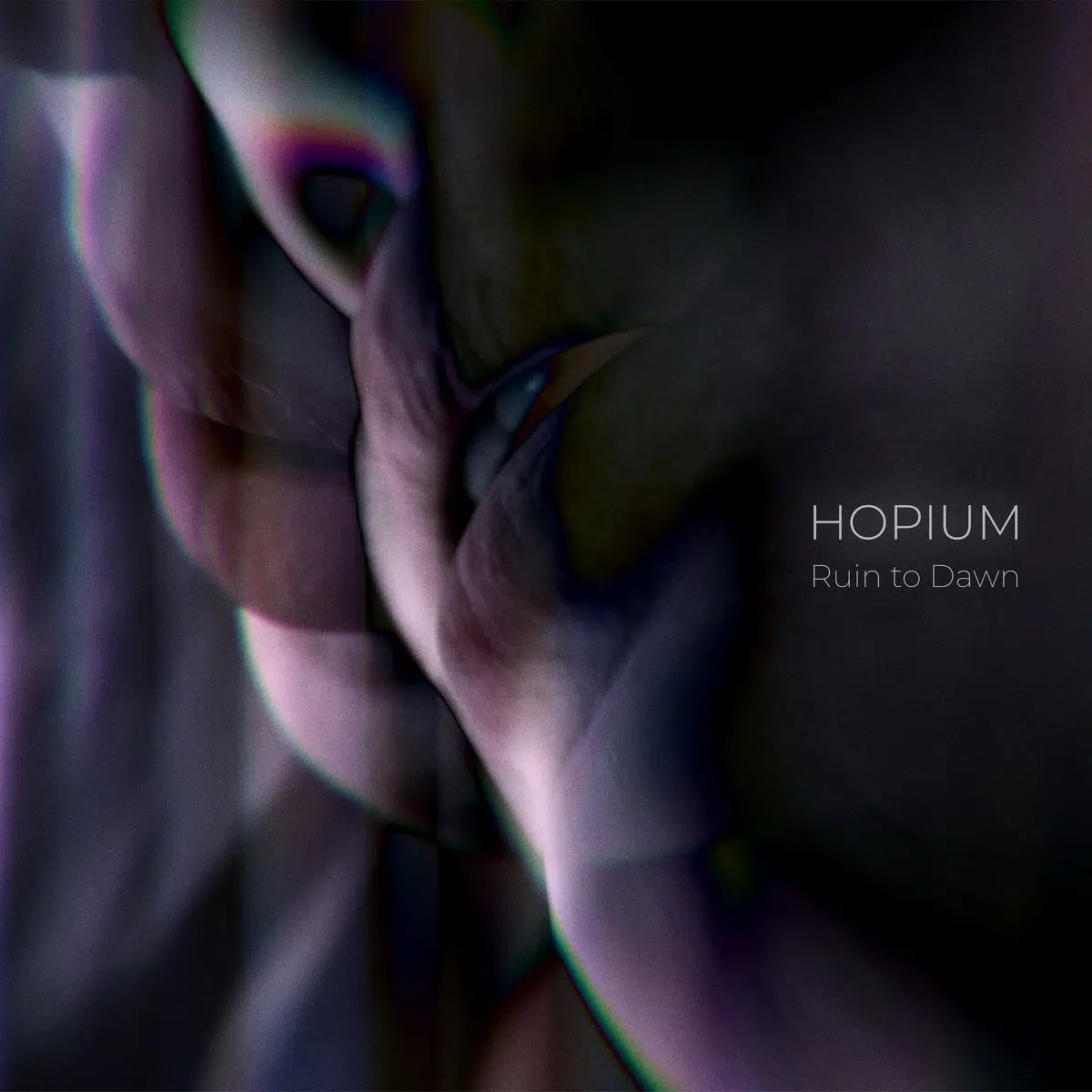
Yi Jing (意境): Hopium – Ruin to Dawn is a spoken-word record built on grief, self-division, and the faint pressure of return. It does not move like a conventional album. It moves like a sequence of interior scenes, short and severe, held together by voice and atmosphere.
Fifi Rong has been working in this territory for a while. She is a Chinese-British vocalist, songwriter, and producer whose catalogue has long folded bilingual writing, emotional exposure, and hybrid electronic production into the same frame. Her work ranges from solo records to collaborations with Tricky, Skepta, Phaeleh, and Yello. Hopium – Ruin to Dawn sits inside that broader arc, but it narrows the method: ten brief pieces, spoken rather than sung in the usual sense, with the whole sequence fixed on collapse, endurance, and renewal.

The wider Yi Jing project gives the album some context. Rong has been building the series as a larger performance and visual work, and the Hopium chapter is presented as the opening volume of her cycle, rooted in personal narrative and in the idea of 意境: a poetic world where voice, atmosphere, and emotion merge. That background helps explain the concentration of the record as a tight, inward piece of work.
“The Grief Tunnel” begins with a muted pulse beneath still water, then closes on “the quiet burial of all possibilities.” “Ruin to Dawn” follows with spent breath, doubt about the soul, and a last ember left alive inside desolation. The movement is clear from the start: not uplift, nor collapse. This is an album that acknowledges and keeps looking for a way to route around it.
That pressure runs right through the set. “Beast” turns on obsession, insignificance, free will, and the ugly pull of self-hypnosis. “Split” is sharper still – full of witness-hunger, self-division, and self-inflicted pain. The writing can edge toward aphorism, but Rong usually knows when to stop. The short track lengths help. Nothing here is given enough room to sprawl into decorative suffering.
“Nothing Humbles Like Time” is one of the strongest pieces in the collection. A distant perfume without form; an untouchable ideal; a second heartbeat carried by another body – then the title line, plain and heavy. Rong does not overstate it. The language lands cleanly and leaves the silence around it to do the rest.
The bilingual presentation gives the album extra force. English and Chinese sit side by side across the sequence, which adds a second layer of rhythm even before performance comes into it. That suits Rong’s catalogue more broadly, where language, heritage, and sonic framing have often been bound together rather than kept in separate compartments.
There is also a genuine sense of placement within her body of work. Earlier releases and press around Rong often emphasize hybrid production, sensual vocals, and genre-blending reach. This record pares that back. The voice is still central, but here it is used as a carrier for concentrated thought, grief fragments, and hard inward turns. The musical frame is lighter, barer, and more functional. That suits the material.
The danger with a spoken-word record of this kind is repetition. Rong gets past that by shifting the angle of pressure from grief and memory to obsession, surrender, delusion, prayer, and finally mercy. “The Universe is a Song” opens the frame out toward metamorphosis and belief. “Mercy” closes with something close to release, where forgetting is treated as grace rather than defeat.
Yi Jing (意境): Hopium – Ruin to Dawn holds to its own interior sensibility from first track to last. The voice stays steady. The imagery stays cold. The sequence keeps its shape. That is enough to make the album linger.