Space disco emerged in the late 1970s as a gleaming, synthesizer‑driven offshoot of disco that swapped mirrorballs for starfields and limousines for rocket ships. It took the groove and hedonism of the clubs and pointed them towards imagined futures, drawing heavily on science fiction, space‑race imagery, and the expanding possibilities of electronic instruments. Somewhere between kitsch and cosmic, it became a bridge from traditional band‑based disco to the fully electronic dance music that would define the 1980s and beyond.
From the dancefloor to deep space
By the mid‑1970s, disco had already conquered radio and clubs, but producers were starting to push the sound beyond lush orchestration and soul‑derived vocals. Affordable synthesizers, sequencers, and drum machines opened up new textures, and the post‑Star Wars wave of space‑themed pop culture made outer space a natural destination for dance music fantasy. European studios, in particular, seized on this; fusing four‑on‑the‑floor beats with electronic arpeggios, sweeping string machines, and sound effects borrowed from science fiction soundtracks.
Italian producer Giorgio Moroder was a central figure in the shift from conventional disco into sleek, motorik synth productions that felt both futuristic and hypnotic. Tracks like “I Feel Love,” recorded with Donna Summer in 1977, dispensed with funk rhythm sections in favour of pulsing sequenced basslines and shimmering synth pads. They laid the groundwork for both space disco and later electronic genres. French artist Cerrone followed a similar trajectory, expanding his disco productions with sci‑fi‑influenced arrangements and extended, cinematic structures that seemed designed for interstellar journeys rather than radio edits.
Europe led the musical space race
While disco’s commercial centre remained in the United States, space disco flourished in European studios, where producers had fewer ties to soul and funk traditions and more freedom to embrace synthpop, prog, and soundtrack influences. Munich, Paris and Rome became hubs for this sound, with producers building tracks around sequencer patterns, phased strings, and vocoder‑treated voices that turned singers into artificial narrators from some distant quadrant. Album art and visual presentation reinforced the aesthetic: chrome robots, galaxies, neon grids and star‑cruiser typography signalled that this was disco reimagined as science fiction.
Artists like the French‑based group Space distilled the concept into its purest form. They crafted largely instrumental pieces dominated by insistent basslines, synthetic melodies, and cosmic sound design. Their records avoided traditional verse‑chorus structures; unfolding, instead, like soundtracks to imaginary missions with themes that evoked orbital drift, planetary landings, and zero‑gravity dances. Elsewhere, acts from prog traditions, such as Rockets, leaned into the theatrical aspect: performing in metallic costumes and face paint while blending rock guitars with sequenced electronics and space‑centric lyrics.
From here to eternity
Giorgio Moroder’s late‑70s output is often cited as one of space disco’s foundations, particularly for its emphasis on repetition, technology and futurist glamour. “From Here to Eternity” mapped disco’s sensual pulse onto a rigid grid of sequenced patterns, while his collaborations with Donna Summer suggested a world in which human desire and machine precision could exist in seamless union. Cerrone’s albums, especially “Supernature,” added a more cinematic and sometimes darker edge, pairing disco beats with lyrics about science gone wrong and environmental collapse, set against sweeping, synthetic orchestrations.
Space, led by Didier Marouani, turned away from vocals almost entirely, focusing on melodic hooks played on synthesizers over steady, mid‑tempo grooves that lent themselves to both clubs and home listening. Their tracks helped define the smoother, more contemplative side of the style; contrasting with the harder, rock‑tinged approach of Rockets, who used vocoders, distorted guitars and dramatic stagecraft to push a more aggressive vision of the future. Later, producers and DJs would look back to these records as blueprints for how to fuse escapist imagery with functional dance music.
A bridge to italo, electro and beyond
Although space disco never became as commercially dominant as mainstream disco, its influence seeped into several strands of early 1980s dance and pop. Italo disco borrowed heavily from its sleek synths, robotic basslines and fantasy‑driven imagery, replacing some of the cosmic themes with romance and nightlife but keeping the same emphasis on programmed rhythms and electronic hooks. Early electro and synthpop, likewise, inherited the idea that machines could be the primary engine of dance music – turning the studio into a laboratory where rhythm and timbre mattered more than traditional band line‑ups.
In the 1990s and 2000s, as DJs and collectors rediscovered obscure European disco 12‑inches, space disco saw a modest revival, inspiring new artists to revisit its combination of retro futurism and straightforward dancefloor functionality. Contemporary electronic musicians have sampled, reissued and referenced these records, treating them as missing links between 1970s disco, 1980s synth music, and modern club culture. Heard from today’s vantage point, space disco occupies a distinctive corner of musical history: too eccentric to be pure mainstream disco; too early to be techno; but crucial in showing how the dancefloor could become a launchpad for imagined futures.
Space – Magic Fly
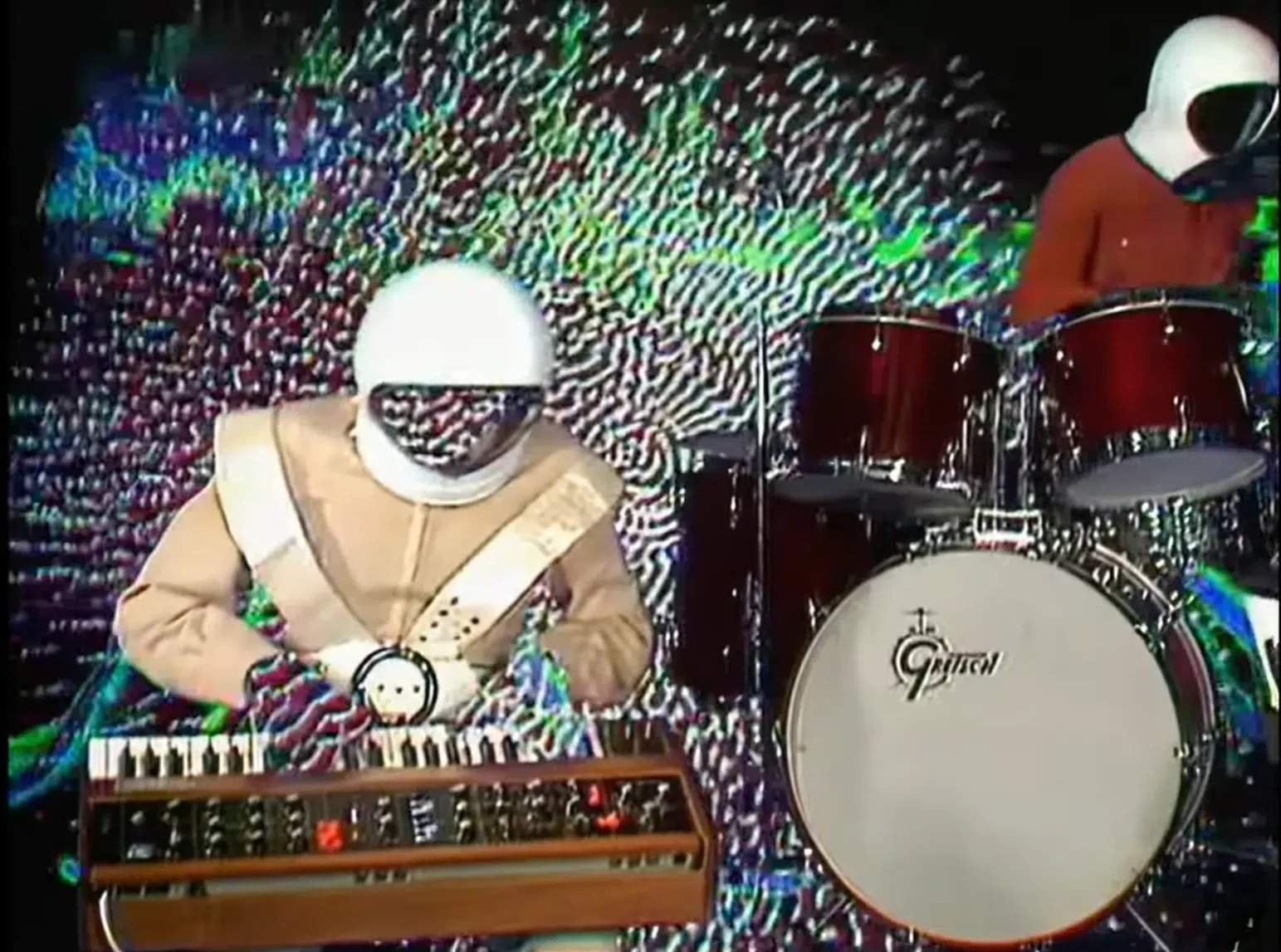
If space disco has an anthem, it is Space’s “Magic Fly.” A studio project built around Didier Marouani, Space took the pulse of Eurodisco and stripped it back to sequenced basslines, synth leads, and wordless hooks. The imagery took a leap, too: swapping gospel‑trained vocalists for helmets and chrome jumpsuits. Released in 1977, “Magic Fly” was one of the first synth‑led instrumentals to become an international hit, topping charts in continental Europe and breaking into the UK Top 10 while sounding like it came beamed into Jodrell Bank.
Space’s records helped codify the genre’s sonic palette: sweeping string machines; simple but hypnotic melodies; and arrangements that feel more like theme music for imagined missions than conventional verse‑chorus pop. When later producers talk about “cosmic” or “spacey” disco, they are often reaching back – knowingly or not – to the template set by Marouani’s studio experiments.
One of the groups that was influenced by the look and feel of “Magic Fly” is Sweden’s Page, which reproduced this classic video for their own alternative hit, “Som ett skal.”
Kraftwerk – Spacelab
Kraftwerk were never a disco act, but their precision‑engineered minimalism shaped the entire European electronic landscape that created space disco. By the time of the 1978 album The Man‑Machine, they had refined their sound into a cool, aerodynamic form: metronomic drum machines; repeating synth figures; and vocoder‑flattened voices that portrayed humans as part of a larger technological system.
“Spacelab” is the group’s most explicit brush with space disco aesthetics. Its steady electronic pulse, rising arpeggios, and slow‑unfolding melody align comfortably with late‑70s cosmic disco, even as it retains Kraftwerk’s sense of conceptual distance and control. Heard alongside the more flamboyant European disco of the time, “Spacelab” feels like the genre’s skeletal blueprint: a reminder that behind the glitter and theatrics lay a fascination with grids, signals and orbiting machines.
Droids – (Do You Have) The Force
Droids were a short‑lived French studio project formed by Fabrice Cuitad and Yves Hayat, arriving just as Star Wars mania helped push space imagery into every corner of popular culture. Their lone album, Star Peace, took that cinematic obsession and rewired it into a playful hybrid of proto‑electro, library music, and disco. Full of bubbling synth lines and phased effects that feel like they belong on a B‑movie soundtrack, Droids’ output leaned heavily into the possibilities of their instruments.
“(Do You Have) The Force” is their definitive statement: a looping, sequencer‑driven instrumental that nods to Giorgio Moroder and Jean‑Michel Jarre while keeping one foot firmly on the dancefloor. It did not trouble charts in the way “Magic Fly” did, but it became a cult favourite among DJs and collectors. It was later cited as an influence on French electronic acts who appreciated its mix of kitsch concept and forward‑looking sonics.
Giorgio Moroder – From Here to Eternity
Giorgio Moroder is more often filed under “disco pioneer” than “space disco artist,” but his late‑70s run is one of the genre’s load‑bearing pillars. From studios in Munich, he pushed disco away from live rhythm sections and towards fully sequenced, synthesizer‑only arrangements; proving that machines could carry both groove and glamour.
“From Here to Eternity” distils his cosmic side: an all‑electronic production built around looping synth patterns, vocoder textures and a relentless four‑on‑the‑floor pulse that feels like a rocket engine locked at cruising speed. Where many space disco records leaned into novelty, Moroder’s work suggested a sleek, adult futurism. It’s the same sensibility that underpinned his productions for Donna Summer and would later echo through Hi‑NRG, Italo, and techno.
Cerrone – Supernature
French drummer‑producer Cerrone came to prominence with orchestral, club‑friendly disco, but “Supernature” marked a decisive turn towards the synthetic and the futuristic. Released in 1977, the track fused a driving disco beat with ominous synth lines and lyrics about bio‑engineering and environmental catastrophe, bringing science‑fiction themes squarely into the centre of European dance music.
In the context of space disco, “Supernature” stands out for its mood. Instead of wide‑eyed optimism about the future, it hints at dystopia – using swirling electronic textures and dramatic string arrangements to suggest a world where scientific progress has gone very wrong. That tension between irresistible groove and unsettling narrative helped broaden the emotional range of the genre and made “Supernature” a touchstone for later producers drawn to darker shades of cosmic disco.
Rockets – On the Road Again
Rockets began in mid‑70s Paris as a rock outfit, but quickly evolved into a silver‑painted, sci‑fi‑themed band whose sound drifted towards disco and later synth‑pop. Their look – chrome costumes, alien make‑up, laser‑lit stages -embodied space disco’s theatrical side, while turning their shows into low‑budget science fiction spectacles.
Their version of “On the Road Again” reimagines the Canned Heat classic as a stomping, interstellar march, with electronic drums, phased guitars and synth leads replacing bluesy looseness with mechanised momentum. It captures the moment when rock, disco and space‑age kitsch collided in European studios, and it remains one of the most recognisable crossover points between space rock and space disco.
Ganymed – It Takes Me Higher
Austrian group Ganymed embodied the pan‑European character of space disco, blending hard rock, glam and Eurodisco into a sound that felt simultaneously tongue‑in‑cheek and genuinely futuristic. Active around the late 1970s, they adopted full sci‑fi stage personas and costumes, presenting themselves as an alien band visiting Earth to bring otherworldly dance music.
“It Takes Me Higher” is their standout space disco moment, built on a chugging beat, phased guitars and sweeping synth hooks that could have soundtracked a vintage TV space opera. It showcases the genre’s ability to accommodate rock textures without abandoning the four‑on‑the‑floor engine, opening the door to the more muscular strains of cosmic dance music that would surface in later decades.
Kebekelektrik – War Dance
Kebekelektrik (a play on the phrase, Quebec Electric) was a studio project led by Canadian producer Patrick Lussier, who was recording in Montreal but drawing heavily on the European space disco sound. They were produced by Pat Desario, who went on to guide Rational Youth’s debut album, Cold War Night Life. Their work sits at the intersection of disco, progressive rock and early synth music, with extended instrumental passages that prioritise atmosphere and texture over pop song structure.
“War Dance” stretches the space disco blueprint into an almost symphonic form, with long builds, layered synthesizers and a sense of narrative progression that feels closer to a film score than a club single. It became a favourite among DJs who wanted to take dancers on a more expansive journey, and it points towards the more “cosmic” DJ culture that would develop in Italy and elsewhere in the early 1980s.
Universal Robot Band – “Disco Boogie Woman”
Unlike many of the studio‑centric European projects, Universal Robot Band emerged from the New York disco infrastructure connected to producers like Patrick Adams and Greg Carmichael. Their name and branding leaned into the robot imagery that was becoming popular, and the music fused American funk and soul roots with an increasingly synthetic edge.
“Disco Boogie Woman” is not space disco in the European sense of instrumental, sci‑fi‑themed tracks, but it captures the parallel Afro‑futurist angle on cosmic dance music – using tight rhythm sections, swirling keyboards and occasional electronic flourishes to imagine liberation through technology and nightlife. Placing it alongside the more Euro‑centric examples underlines how “space” in disco could mean either literal rockets and planets or a metaphorical leap into a freer, more technologically charged future.
Zodiaks – The Mysterious Galaxy
Zodiaks from Riga deserves a place in any serious account of space disco. Formed in 1979 by Jānis Lūsēns and fellow Latvian conservatory students, the group became the Soviet Union’s answer to French acts like Space, with a sound built on synthesizers, sequencers and cosmic instrumental themes. Their breakthrough album, Disco Alliance, helped define a distinctly Soviet strain of space disco: polished, melodic, and far more atmospheric than ordinary pop-disco; yet still driven enough for the dancefloor.
What makes Zodiaks especially important is how clearly they translated the broader European space-disco vocabulary into a Latvian and Soviet context. Lūsēns has described the band as being inspired by Kraftwerk, Tangerine Dream, and Jean-Michel Jarre, which helps explain why their music feels both futuristic and carefully composed rather than merely fashionable. The follow-up, Music in the Universe, deepened that identity, blending prog-like structure, electronic textures and cosmic imagery into a sound that has become a cult reference point for collectors of Eastern Bloc synth music.