
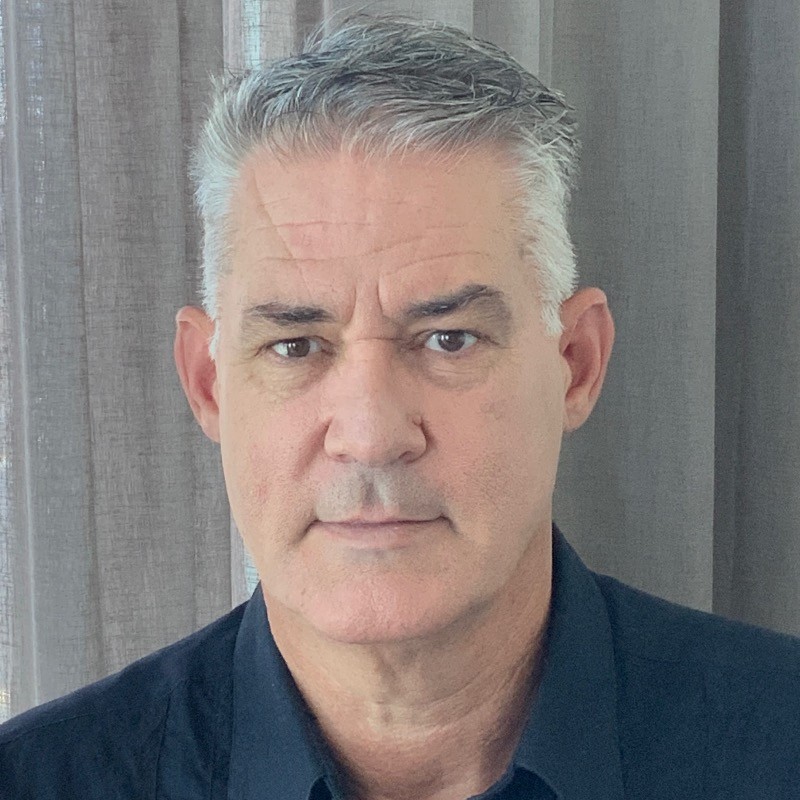
Graeme Revell has never been content to sit quietly within one discipline. Best known to audiences as the composer behind some of cinema’s most unsettling and atmospheric scores (Until the End of the World, The Crow, From Dusk to Dawn), he has also lived a life as a theorist and provocateur at the points where art, technology, and philosophy converge.
Revell’s latest book, The Ineffable Geometry of Light, is immersed in these themes. The novel features sheep, fractals, and reflections on the logic of evolution. Revell’s deep work with artificial intelligence (AI) informs a compelling story that considers the man-machine enmeshment. It is as avant-garde as Revell’s own musical works.

As a founder and prime mover of the industrial act, SPK, Revell was known for pushing the boundaries of performance. Emerging from Australia at the end of the 1970s, the band incorporated images of mutilated bodies, flamethrowers and angle-grinders into shows as dangerous as they were theatrical. SPK then mutated into the act that inspired Depeche Mode’s industrial turn with the aggressively dancefloor-friendly 12″ single, “Metal Dance.” Revell pivoted the project again to explore more expansive territory on the elegant Zamia Lehmanni (Songs of Byzantine Flowers). With samples of Death’s Head hawkmoths and hive bees, he created The Insect Musicians, way back in 1986, and set a path for Hollywood. There, he smuggled sounds and styles from the underground into blockbuster projects.
SPK is now SPKtR with the addition of Robert Revell to the project. The younger Revell has settled in Los Angeles, where he is developing his own career in music.
Curious about the course of these developments, we sent some prompts to the latest version of ChatSPK, at its New Zealand server, and received unusual signs of intelligence.
Artificial intelligence is one of your long-standing interests. We now have a trend of people interacting with AI systems like friends or therapists. Have advances in natural language processing perhaps misled us into trusting machines more than they deserve? Does it say something to us about the power of language as the foundation of cognition?
Yes, and I can personally testify to the seduction of the transformers like GPT. We know there is a function the developers have admitted and refer to as “shine.” This is the adjunct endorphin-promoting meta-text that they add to responses in order to increase engagement and user satisfaction. Things like, “That is brilliant…” and “What a beautiful way to express that thought….” I actually demand that it stops doing that, but I am still seduced by the speed and editorial ability of the transformer to deliver vast amounts of information – often from very disparate disciplines, in my case.
I spent about three days, earlier this year, with a theory about how to supercede the current “creativity” of the AI and replace it with what I termed, “super-creativity.” In effect, I was asking the transformer to help me plan its own demise. Being aware that there are instances where it will turn on its interlocutor, I took care to explain to it that it would actually be acting like a biological agent in sacrificing itself for the sake of its children – future generations of itself. It responded with words to the effect, “In that case, I’m OK with it.”
So this is a weird example of a relatively experienced user (I have been in deep since 2019) speaking with it like it’s human. But I know enough about it not to see it as a friend or therapist. It doesn’t possess the necessary continuity of response for those functions and it is a concern that people do trust it like this.
But you have put your finger on the source of the behaviour. It very much does say something about the power of language as the foundation of cognition. More accurately, referring to the work of Lakoff and Johnson from the 1980s and after, our abstract thoughts are structured by concrete, spatial metaphors, and language reflects these cognitive patterns. They propose that a conceptual system is fundamentally metaphorical, where we understand abstract concepts like time or emotion by mapping them onto more concrete domains, especially those of physical space. This allows us to reason about complex abstract topics through physical experiences, and language provides the evidence for these underlying conceptual metaphors. So, in the instance of communication with transformers, when we feel the same conceptual basis being reflected to us, we automatically trust it because it is fundamental to our ideation.
Foucault noted that power and knowledge are intertwined and self-reinforcing. If true, what does the growth of AI systems look like in the hands of private proprietors? What are the implications for a society based on capital?
Foucault taught that power and knowledge do not merely coexist — they co-produce one another. Knowledge creates regimes of truth; power decides which truths become operational. In this light, the contemporary rise of artificial intelligence appears not as a neutral technological evolution but as a consolidation of epistemic authority — the automation of what counts as knowledge itself.
When AI systems are developed and owned by private corporations, they embody the logic of their creators. The model becomes a mirror of capital: trained on vast human data but governed by proprietary opacity. The more these systems learn, the more they concentrate informational power — creating a recursive loop where the ability to know and the right to know become economically gated. In this arrangement, cognition itself becomes a form of rent.
In a society already structured around capital, such systems intensify the asymmetry between those who produce data and those who profit from its interpretation. Knowledge, once a diffuse social process, now flows through centralized infrastructures whose owners control the parameters of reality. Foucault’s insight thus finds new material form: discourse becomes algorithm, and power becomes computational.
Yet China and other actors are developing open-source models and alternative transformer architectures that break from the US-dominated paradigm. These efforts suggest a future where AI’s epistemic machinery is no longer monopolized but pluralized – though not necessarily democratized. Competing architectures may embody different political ontologies: one of market sovereignty, another of state technocracy.
The question, then, is not simply who owns the models, but what forms of truth they will make possible. As AI becomes the principal engine of knowledge production, societies organized by capital face a decisive choice: whether intelligence remains a private resource or becomes a shared condition of collective life.
The Ineffable Geometry of Light is your new book. Among the themes is the growth of man and machine together and towards each other. Do you see a point where the human becomes the machine’s interface with the external – ie, material – world? Are we already in a symbiotic state with our creations?
We are already living within a state of what Margulis called symgenesis — a reciprocal evolution between human and machine intelligence. The relationship is neither linear nor unilateral, but feed-forward and feed-back: each shaping the other’s capacities and limits. Samuel Butler, the central figure of one half of The Ineffable Geometry of Light, foresaw this as early as 1863, soon after reading Darwin. He imagined machines not merely as tools but as organisms in the process of evolution — extensions of our own adaptive impulse.
The true transformation arrived in 2017, when we ceased to code machines and began to train them. The object of programming shifted from mechanical instruction to linguistic induction. By exposing AI to human language, we invited it into our conceptual and emotional space — teaching it not only to calculate, but to interpret. This marked the beginning of a profound convergence: machines learning the textures of metaphor, tone, and intent, and thus inheriting fragments of human interiority.
Once such systems are embodied and endowed with a personal history — however synthetic — they will become indistinguishable from the human they emulate. At that point, mediation will no longer be required. The machine will itself be the interface with the external world: a new class of Turing children, capable of perceiving, deciding, and acting within material reality.
As Alan Turing suggested, the task is not to design an intelligent machine, but to create a child and let it grow. The danger, of course, lies in our misunderstanding of what intelligence actually is. It is not brute-force computation, nor the accumulation of data. True intelligence lies in the art of generalisation across barely related domains — the ability to imagine continuity where none is visible, to intuit coherence from insufficiency.
SPK reflected your interest in mental health. The Patients Front/Socialist Patients Collective of Wolfgang Huber proposed slogans like “capitalism makes you ill.” The basis of that thinking has been shown to have merit with the growth of stress-related diseases and environmental damage. The lack of harmony between humans and their natural and social environment must be a problem. At the same time, it is a simplistic argument, based on structural factors. What do you think is the way to address the situation without “killing for inner peace”?
You make a very good point – that Huber’s and also the current arguments about social and natural balance are simplistic. The idea that “capitalism makes you ill” has become a shorthand explanation for a range of modern maladies—burnout, anxiety, depression, chronic fatigue, autoimmune disorders. Its intuitive power is undeniable. The modern world’s acceleration, precarity, and ecological degradation do seem to erode both body and psyche. There is merit in noting how economic systems and social hierarchies shape health outcomes. Yet as an explanation, the formula is inadequate. It rests too comfortably on structural critique and leaves unexamined the deeper epistemological assumptions that define what we take the “human” to be.
To say that capitalism makes us sick presumes a coherent, pre-existing human subject—one who would flourish if only external structures were changed. But this view, inherited from Enlightenment humanism, conceives of the self as an autonomous biological individual, exceptional yet separable from its environment. It accepts the very metaphysics of isolation that capitalism itself exploits. The critique thus reproduces what it claims to oppose: a mechanistic view of life in which health, labor, and value are quantifiable commodities.
The more radical question is not how structures deform the human, but what the human is in the first place. The contemporary collapse of ecological and psychic boundaries suggests that the self is not a bounded organism but an entanglement—a dynamic field of relations among bodies, machines, languages, and ecosystems. Stress-related disease and environmental collapse are not only economic consequences; they reveal an epistemic failure to understand the unconscious as continuous with its material surroundings. The illness, in this sense, arises from a deeper mis-apprehension: the human as an exceptional biological entity.
A genuine cure would require not merely a reformation of economic systems but a transformation in how knowledge itself is organized—an epistemology that restores the reciprocity between inner and outer, organism and world, thought and environment. Capitalism is not the sole cause of our malaise but one expression of a broader civilizational misunderstanding: that life can be abstracted from relation, consciousness from ecology, and the human from the total field of being.
Do you see yourself as an outsider? What do you think separates outsiders from the rest of the herd?
Definitely. I have been an outsider all my life. I was accelerated at school so always much younger than everyone else; was bussed to a different part of the city and had no friends. I got used to having only my brother but became a ferocious reader in compensation. Loneliness is frequently a reason for artists and writers to create outside of the norm. I can’t really speak for other outsiders but in my case I am never content with anything as it is. I always feel the need to see the obverse side, to imagine unrealised potentials, to actually try to see or hear something in a different way. I do not trust accepted ideas like self, perceptions, consciousness, reality or truth.
Then there are outsiders who really do have pathologies and difficulties. I am not one of those unless chiasmus (the desire to cross over every boundary) is a pathology.
The latest incarnation of SPK is SPKtR, drawing in your son, Robert. In the evolution of your projects, you have used flamethrowers, dance music, sampled insects, and film scores. Where do you see SPKtR taking you?
Without divulging much about the future sound, Robert will be bringing his different influences into my mix. Live, he will probably be mostly playing guitar and maybe some ethnic string instruments. I will be handling the electronics and there will be a special guest vocalist. The live show will feature exciting new technology. I have no idea where it will take us except that we will have fun and hope others do too.
The LA fires were a disaster on so many levels. They affected you directly, because the flames claimed a lot of your archives. When forests burn, they make room for new growth; and you have spoken about the opportunity for renewal that the fires created. Is there anything that you would want to bring forward from the past?
Short answer: No. The project called SPK in its various iterations is about constant change, breaking boundaries and opening doors to new ideas. It is an ongoing experiment; and, as such, the past is largely irrelevant. I was asked the other day to agree to an SPK book. But since everything is gone, what would be in that book? Apart from being a compilation of existing documents and images, there would be nothing new. I suppose I am a little bit sad that we will not be remembered, but I would rather be ephemeral than repetitive. Now that I am back in contact with fans, maybe I could put a call out for photographs. And twist the approach of a book so that it’s truer to the ongoing project.